Booster Pump Condo Guide for Toronto Buildings
A practical Toronto guide to booster pump condo service, failure signs, replacement costs, shutdowns, and what boards should budget for.
Booster Pump Condo Guide for Toronto Buildings
Quick summary: A booster pump condo problem usually starts as a pressure problem, not a dramatic failure. In Toronto high-rises, the costly mistake is treating resident complaints as isolated in-suite issues when the real problem is a domestic water pump set, control sensor, check valve, or pressure-reducing arrangement in the mechanical room. In fall, this is exactly the right time to inspect the system, confirm operating pressures, and get budget numbers in front of the board before winter demand and pressure swings expose weak equipment.
A common misconception in condominium plumbing is that if water still comes out of the tap, the booster system is fine. In practice, many domestic pump systems fail gradually. On a 25-storey tower in North York or a 30-year-old Mississauga high-rise, the first sign may be three residents on the 18th floor complaining that their shower pressure disappears from 7:00 to 8:30 a.m. while the first-floor superintendent sees nothing unusual. By the time the building has a full no-water event, the board has already missed months of warning.
For boards and property managers, the question is not just whether the domestic water pump can be repaired. The better question is whether you still have a maintainable system with available parts, stable pressure, and enough redundancy to avoid an emergency shutdown. If not, this moves from service work to capital planning quickly. Where it fits, BMI typically starts with a building review tied to broader repairs and service because booster pump issues often overlap with isolation valves, PRVs, and riser condition.
What a booster pump is actually doing in a condo building
Municipal pressure alone is not enough to serve most mid-rise and high-rise buildings in Toronto. Street pressure can vary widely by location and time of day, but many buildings see incoming pressure somewhere around 45 to 80 psi. That is nowhere near enough to reliably push domestic cold water to the top of a 20- to 40-storey tower once elevation loss and friction are accounted for. As a rule of thumb, you lose about 0.433 psi per vertical foot of lift, so a 200-foot elevation gain already costs roughly 86 psi before you even discuss fixture performance.
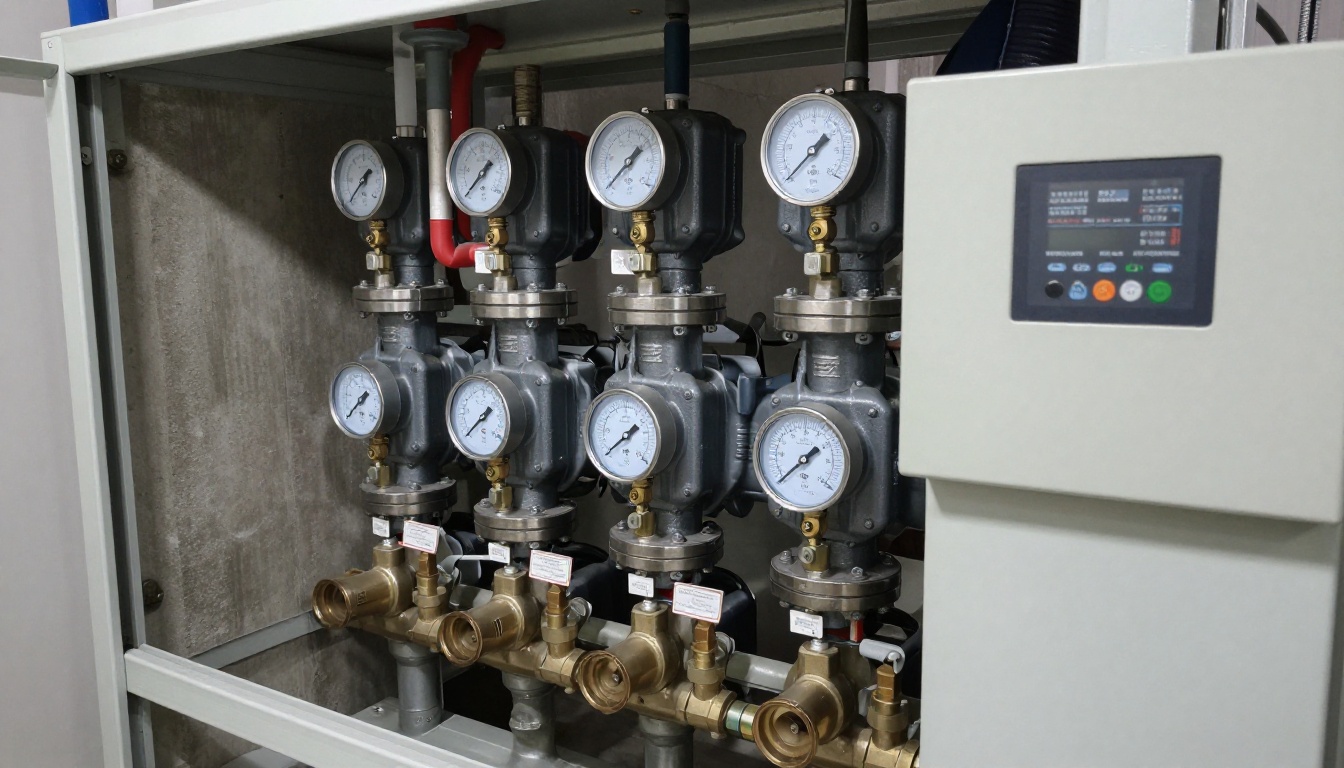
That is why the building has a booster set: usually two to four pumps on a skid, often duty/assist/standby, controlled by variable frequency drives or older pressure switches. The system takes incoming domestic water and boosts it to a discharge pressure high enough to serve upper floors while coordinated pressure-reducing zones stop lower floors from seeing excessive pressure. If your building has never had its pressure profile reviewed, a PRV maintenance assessment is often relevant at the same time, because an upper-floor low-pressure complaint and a lower-floor high-pressure complaint can be two sides of the same system problem.
In buildings we service in Toronto, Scarborough, and Vaughan, the most common arrangements are:
- Hydropneumatic or older constant-speed systems in 1970s and 1980s concrete towers
- Duplex or triplex VFD booster sets in early-1990s to mid-2000s high-rises
- Packaged variable-speed skids in post-2010 glass towers
- Separate domestic cold booster with hot water recirculation support in larger complexes
The technical point many boards miss is that the pump itself is only one part of the system. The failure may actually be the pressure transducer, check valve, bladder tank, VFD, suction isolation valve, discharge header, or even a stuck bypass arrangement. That is why a proper diagnosis matters more than replacing parts on instinct.
How booster pump problems show up in a real building
Property managers rarely receive a ticket saying, “our transducer is drifting.” They receive scattered complaints that look unrelated. A resident in Etobicoke says the shower goes cold when someone else runs water. An owner in Markham says the toilet takes two minutes to refill. The building operator notices Pump No. 2 starts and stops every 20 seconds in the morning peak. These are all useful clues.
The most common symptom patterns are:
Upper-floor pressure complaints during peak demand
- Usually reported between 6:00 and 9:00 a.m. or 6:00 and 10:00 p.m.
- Often affects the top 5 to 10 floors first
- Suggests inadequate discharge pressure, a lag pump not coming on, or a control issue
Pressure swings throughout the building
- Residents describe “surging” at faucets or showers
- Often tied to unstable VFD control, bad transducer feedback, or a failed pressure tank
- Can also expose weak toilet fill valves and faucet cartridges, creating a second wave of service calls to toilet and faucet repairs
A complete no-water or low-water event
- More likely when there is no reliable standby pump or the standby has not been tested under load
- Common in older buildings where one pump has quietly been out of service for months
- This is when buildings end up needing 24/7 emergency plumbing response
Mechanical room evidence
- Seal leakage under the pump
- Bearing noise or vibration in the motor assembly
- Check valve chatter on discharge
- Frequent VFD alarms, overcurrent trips, or pressure faults
A specific field detail worth knowing: if the complaint is truly building-wide but only during high-use periods, it is less likely to be an in-suite blockage and more likely to be a capacity or control problem. By contrast, if one suite has poor hot and cold pressure all day while adjacent suites do not, that points back toward suite isolation valves, fixture stops, or local piping and may justify in-suite plumbing investigation instead.
Why these systems fail in Toronto-area condo stock
Failure patterns track closely with building age. In 1970s and 1980s towers in York, North York, and parts of Mississauga, the original booster equipment may have been designed around older constant-speed controls and heavier steel components. Some of those systems are surprisingly durable, but they often have poor energy performance, limited redundancy, and hard-to-source controls. In early-1990s towers, the pump bodies may still be serviceable while the controls are approaching obsolescence.
The most common failure modes BMI sees are:
1. Mechanical seal failure
A domestic booster pump seal can start weeping long before it becomes an emergency. Once leakage reaches the motor or creates standing water around the base, the risk changes from a maintenance issue to a shutdown issue. Seal failures are often accelerated by dry-running, suction problems, or vibration.
2. VFD and control failure
Variable frequency drives are excellent for pressure stability and energy reduction, but they do not last forever in warm mechanical rooms. Capacitors age, cooling fans fail, and boards become unsupported. In a 12- to 18-year-old installation, the bigger risk is not that the drive fails once; it is that the exact replacement is no longer available.
3. Pressure transducer drift
This is one of the most misdiagnosed problems in condominium plumbing. A transducer that reads 8 to 12 psi off can make the pumps hunt, overrun, or under-deliver while the physical pumps are mechanically fine. Replacing a good pump because the sensor lied to the controller is an expensive mistake.
4. Check valve or isolation valve problems
A leaking discharge check valve can allow reverse flow and unstable pressure. A partially seized suction or discharge valve can starve the system under load. This is where a current valve audit and charting program has real value, because a booster pump replacement goes badly when the supposed isolation valves do not close.
5. System mismatch after building changes
A building that added larger shower systems, more in-suite laundry, or renovated common amenities may have increased peak demand without revisiting pump sizing. In post-2010 towers, the problem is not always age; sometimes the original design margin was simply too thin.
Another local factor is Toronto water conditions. Municipal water is treated and generally consistent, but valve scale, sensor fouling, and small-bore control line issues still occur, particularly where maintenance has been reactive rather than scheduled. Booster systems also interact with domestic hot water recirculation and PRV zones, so a pressure complaint is not always a pump-only issue.
What a proper diagnosis should include before anyone recommends replacement
If a contractor tells you a booster set needs replacement after a quick walk-through and no readings, get a second opinion. A credible diagnosis should produce evidence, not just a conclusion. In most buildings, that means some combination of:
- Static and dynamic pressure readings at the incoming service, suction header, and discharge header
- Setpoint confirmation for cut-in/cut-out or VFD pressure control
- Amp draw and run status for each pump motor
- Verification that lag and standby pumps actually rotate and carry load
- Inspection for seal leakage, vibration, and check valve performance
- Review of alarm history on the controller or BMS where available
- Confirmation that isolation valves hold
This is also where a building-wide view matters. If the mechanical room diagnosis points toward broader domestic water issues, a camera inspection is not the tool for the pump itself, but it may still be relevant elsewhere in the building if operators are also chasing unrelated drainage complaints. Too many boards treat each water issue as isolated when the maintenance record is really telling one story: aging infrastructure.
For a defensible report to the board, ask for:
- Existing pump make, model, horsepower, voltage, and configuration
- Current operating pressure and target pressure range
- Condition of pressure tanks, gauges, transducers, and check valves
- Whether replacement parts are readily available in Ontario
- Whether temporary repair buys 6 months, 2 years, or neither
- Whether the replacement can be done like-for-like or requires redesign
If the building has not maintained its domestic pressure controls, this is also a good time to look at maintenance programs rather than another cycle of crisis calls.
Repair versus replacement: a decision framework that boards can use
Not every weak booster system needs immediate capital replacement. Sometimes the right answer really is, “repair it and revisit next budget year.” The key is to be honest about what you are buying with that repair.
Repair usually makes sense when:
- The system is under 15 years old
- Pump casings and motors are structurally sound
- The issue is clearly a seal, bearing, transducer, check valve, or VFD component
- OEM or equivalent parts are available quickly
- The building still has true redundancy during repair
Typical repair items include seal kits, bearings, couplings, pressure sensors, gauges, check valves, and some drive components. If the issue is one failed transducer on an otherwise healthy skid, replacement of the entire system would be hard to justify.
Replacement usually makes sense when:
- The pump set is 20 to 25+ years old
- Controls are obsolete or unsupported
- Repeated failures are causing resident disruption
- Only one pump is really carrying the building
- The skid lacks safe isolation, bypass, or maintainability
- The building is already planning major domestic water work such as riser replacement or broader building re-piping
A common mistake we see in older Toronto and Richmond Hill towers is putting $8,000 to $15,000 into reactive repairs over 18 months on a system that should have been replaced after the second major failure. Boards often do this because each individual repair seems cheaper than a $60,000 capital project. In aggregate, it is usually not.
There is also a middle option: staged modernization. On some skids, controls and drives can be upgraded before the hydraulic end is replaced. That approach can make sense where access is difficult or reserve timing is tight, but only if the remaining mechanical components justify it.
What booster pump service and replacement cost in Toronto
The numbers below are realistic GTA market ranges, not fixed prices. Access, electrical scope, after-hours requirements, and the age of surrounding valves can move them materially.
| Scope | Typical Toronto market range | Notes |
|---|---|---|
| Diagnostic site visit with pressure testing and condition review | $750 - $2,500 | Depends on complexity, documentation, and whether multiple visits are needed |
| Pressure transducer replacement | $600 - $1,800 | Sensor type, calibration, access, and controller integration matter |
| Mechanical seal repair on one pump | $1,500 - $4,000 | Excludes major motor damage or shaft issues |
| Check valve replacement at pump discharge | $1,200 - $3,500 | Depends on size, valve type, and isolation reliability |
| VFD repair or replacement for one pump | $3,500 - $12,000 | Older drives can be difficult if parts are obsolete |
| Small booster skid controls refresh | $8,000 - $20,000 | Partial modernization, not full pump replacement |
| Full booster pump set replacement | $35,000 - $90,000 | Typical condo range for many mid/high-rise buildings |
| Larger tower or complex full replacement | $90,000 - $150,000+ | Higher flow/head, electrical upgrades, difficult logistics |
A few cost drivers that boards often underestimate:
- Electrical work: disconnects, starters, VFD integration, and commissioning can be a major part of the job
- Valve failures during shutdown: if old suction or discharge valves do not hold, the scope can expand into valve replacement
- Rigging and access: some mechanical rooms were not designed for easy removal of old skids
- Temporary water service or bypass pumping: useful in some occupied buildings, but not free
- After-hours work: many condos prefer overnight or shoulder-hour shutdowns to reduce resident impact
On a 300-unit building, the board should also think in per-unit terms for reserve planning. A $60,000 booster replacement is roughly $200 per unit before financing or contingency. Presented that way, the project is often easier for boards to discuss rationally.
Shutdowns, timing, and resident logistics
Booster pump projects succeed or fail operationally based on planning, not just installation quality. In an occupied condo, the actual pump swap may be one day, but the planning around it starts earlier.
A realistic sequence is often:
- Site review and condition assessment: 1 to 2 visits
- Budget pricing or tender support: 1 to 3 weeks
- Equipment lead time: commonly 4 to 10 weeks, sometimes longer for specialty controls
- Resident notice planning: usually 48 to 96 hours minimum for shutdown notices, often more under site rules
- Installation and shutdown: frequently 1 long day or 2 shorter phases
- Commissioning and balancing: same day plus follow-up
The hidden risk is not the pump lead time. It is discovering on shutdown day that the building’s isolation valves do not fully close. That is why a valve audit before major mechanical work is money well spent in many 1980s and 1990s buildings.
For fall planning, this matters because boards are finalizing next year budgets now. If your booster system is noisy, unstable, or one failure away from a full outage, October and November are the right months to inspect and budget it. Waiting until January means competing with winter emergencies, holiday staffing gaps, and resident tolerance that is already lower because pressure complaints are more disruptive in cold weather.
What happens if the building defers the work
Deferral is not always irresponsible. Sometimes the right decision is to monitor a serviceable system and budget replacement for the next fiscal year. But deferral should be informed.
Here is what typically gets worse when a failing booster system is left alone:
- Resident complaints multiply because pressure instability affects many fixture types, not just showers
- Secondary fixture failures increase as fill valves, cartridges, and mixing valves get stressed by surging
- Emergency shutdown risk rises if the standby pump has not been load-tested or if obsolete controls fail outright
- Insurance exposure becomes harder to defend if records show repeated warnings and no action
Boards should also think about reserve fund optics. A domestic booster set is classic reserve-fund infrastructure in most condos, even if the immediate trigger is a repair event. If your reserve fund study is due for a Class 1, 2, or 3 update, or if the board is reviewing next-year allocations under the Condominium Act, 1998, this is the kind of equipment that should not live in an operating-budget grey zone forever.
Responsibility is usually straightforward: the booster set is a common element, not an owner-maintained component. The declaration still governs, but if the pressure problem is tied to the central pump system, the corporation generally owns the remedy. That matters when residents ask whether the corporation can charge back a service call. In most cases, not if the root cause is central.
There is also a practical legal point: plumbing work on a condominium domestic water system should be performed by a properly licensed plumbing contractor operating within Ontario’s trade framework. Boards should want records, shutdown notices, and commissioning documentation, not just a verbal assurance that “it’s fixed.”
What to ask for when getting quotes
Boards get better outcomes when they ask better questions. For a booster pump quote or condition report, ask each contractor to state:
- Existing system configuration: duplex, triplex, lead-lag, standby
- Required flow and head, or whether they are assuming like-for-like
- Whether the quote includes controls, transducers, gauges, check valves, and commissioning
- Required electrical scope and who carries it
- Whether temporary bypass pumping is included or excluded
- Expected shutdown duration and resident notice requirements
- Whether old isolation valves are assumed to hold
- Lead time for equipment and parts
- Warranty terms for both equipment and labour
This is also the point where building history matters. If the same property has aging PRVs, poor isolation, or domestic riser issues, a contractor who also understands project solutions for multi-residential plumbing will usually give a more realistic plan than someone treating the pump as a standalone box.
For buildings that want proof of how similar work has been approached in occupied towers, reviewing a contractor’s completed project portfolio is useful, especially when the building is trying to compare a repair-minded proposal against a capital replacement recommendation.
FAQs
How long does a domestic water booster pump last in a condo building?
In Toronto condominium service, a booster pump set often lasts 15 to 25 years, but the life of individual components varies. Variable frequency drives may need attention around 10 to 15 years, mechanical seals can fail much earlier, and pressure transducers are common nuisance-failure items after 5 to 10 years. A 1990s pump skid that still runs is not automatically healthy if parts are obsolete or if the building has repeated low-pressure complaints.
What are the first signs that a booster pump is failing?
The earliest signs are usually inconsistent pressure rather than a complete outage. Residents on upper floors may report weak shower pressure between 6 and 9 a.m., toilets that refill slowly, or pressure swings when another fixture opens. In the mechanical room, operators often see pumps short-cycling, alarms on the VFD, leaking seals, or discharge pressure drifting outside the usual setpoint by 8 to 15 psi.
Can a booster pump be repaired, or does the whole system need replacement?
Many failures are repairable if the skid is structurally sound and parts remain available. Seal changes, bearing work, transducer replacement, check valve replacement, and VFD repairs can make sense when the system is under roughly 15 years old and the controls are not obsolete. Full replacement is usually the better decision when the pumps are beyond 20 years old, the controller is no longer supported, or the building has recurring outages that are now affecting resident service and risk.
What does booster pump replacement cost in Toronto?
For a typical mid- to high-rise condo in Toronto, a like-for-like booster pump replacement commonly lands in the range of about $35,000 to $90,000, depending on pump count, flow, head, controls, access, and whether electrical upgrades are needed. Larger towers or systems with substantial control integration, inertia base work, or after-hours shutdown constraints can exceed $100,000. Those are market ranges, not fixed prices, and the difference between a simple skid swap and a full room upgrade is significant.
Does replacing a booster pump require a full building water shutdown?
Usually yes, at least for part of the work. In a typical occupied condo, there is often one major shutdown window of 6 to 12 hours, sometimes split into two phases if temporary bypass pumping is used or if valves do not hold. The practical issue is not just the pump changeout itself; it is whether the building has reliable sectional isolation, accurate valve charts, and enough notice to residents for toilets, showers, and domestic hot water interruption.
Who is responsible for a booster pump problem: the corporation or the suite owner?
In almost every condominium, the domestic booster pump set is a common element, so diagnosis, repair, and replacement are corporate responsibilities. What creates confusion is that the symptom appears inside a suite, especially on upper floors, where owners may think they need an in-suite plumber. The declaration governs responsibility, but if multiple suites or entire vertical zones are seeing pressure issues, the problem is usually not chargeable to one owner.
Next steps for boards and property managers
If your building has had upper-floor pressure complaints, unexplained pump alarms, or a booster set that has not had a serious review in several years, do not wait for a no-water event. In fall, the practical move is to get a condition assessment done now, confirm whether the issue is serviceable, and decide whether this belongs in the current operating plan or next year’s capital budget.
A useful rule of thumb is simple: if the system is over 15 years old and you cannot clearly answer what pressure it is maintaining, whether the standby pump actually carries load, and whether replacement parts are available, you do not yet have enough information to defend deferring it.
For Toronto, North York, Mississauga, Vaughan, and surrounding GTA condominium buildings, BMI attends the site before quoting because booster pump recommendations are only credible when they reflect the actual mechanical room, valve condition, access constraints, and resident logistics. If the issue is urgent, emergency plumbing response is available 24 hours a day. If it is not urgent, the better approach is usually a scheduled inspection with a written plan through Brial Mechanical’s contact page or by reviewing related guidance on the BMI blog.
Contact BMI
- Contact BMI
- Phone: (416) 845-3756
- Emergency: (416) 845-3756, answered 24 hours a day
- Email: info@brial.ca
More on condominium plumbing
Grease Interceptor Condo Guide for Toronto Buildings
A practical Toronto guide to grease interceptor condo issues, commercial tenant plumbing risk, costs, maintenance, and …
Toronto Condo Stack Cleaning ROI After 5 Years Deferred
Deferred maintenance cost adds up fast. See the real stack cleaning ROI for Toronto condos after five years without …
Condo Garbage Disposal Rules in Toronto Buildings
Why condo garbage disposal bans are common in Toronto: stack loading, plumbing risk, costs, rule enforcement and what …
Need a plumber in your building?
BMI services roughly 200 condominium and multi-residential buildings across Toronto and the GTA. Emergencies are answered at any hour.