Hydro Jetting vs Snaking Condo Waste Stacks in Toronto
Hydro jetting vs snaking for condo waste stacks in Toronto: what each method does, costs, timing, and when a board should approve stack cleaning.
Hydro Jetting vs Snaking Condo Waste Stacks in Toronto
Quick summary: In condominium buildings, snaking and hydro jetting are not interchangeable services. Snaking is mainly a blockage-opening method; hydro jetting is a pipe-wall cleaning method that restores carrying capacity in grease-loaded kitchen and laundry waste stacks. If a Toronto condo board is budgeting for fall maintenance before holiday cooking season, the wrong choice usually means repeat backups, owner complaints and paying twice.
A common budgeting mistake in Toronto, North York and Mississauga is to treat every drain problem as a one-off service call. In multi-residential buildings, repeated sink backups in the same vertical line are usually not random suite issues at all. They are a sign that the stack cleaning method being used does not match the failure mode inside the pipe.
The short answer: snaking opens a path, jetting cleans the pipe
If a building operator only remembers one distinction, it should be this: a snake typically creates or reopens a path through a blockage, while a jetting nozzle cleans the circumference of the pipe wall. That difference matters because most condominium kitchen waste stacks do not fail from a single solid obstruction. They fail because a 3-inch or 4-inch cast iron stack slowly loses effective diameter to grease, starch, soap residue and corrosion roughness until one busy weekend tips it into backup.
In BMI’s kitchen stack cleaning work, the classic fall pattern is easy to recognize. A stack may have been snaked two or three times over the past year, but the same vertical line still backs up when residents run dishwashers heavily around Thanksgiving or the December holidays. That is because the snake reopened a narrow channel through the center while leaving a greasy collar on the pipe wall.
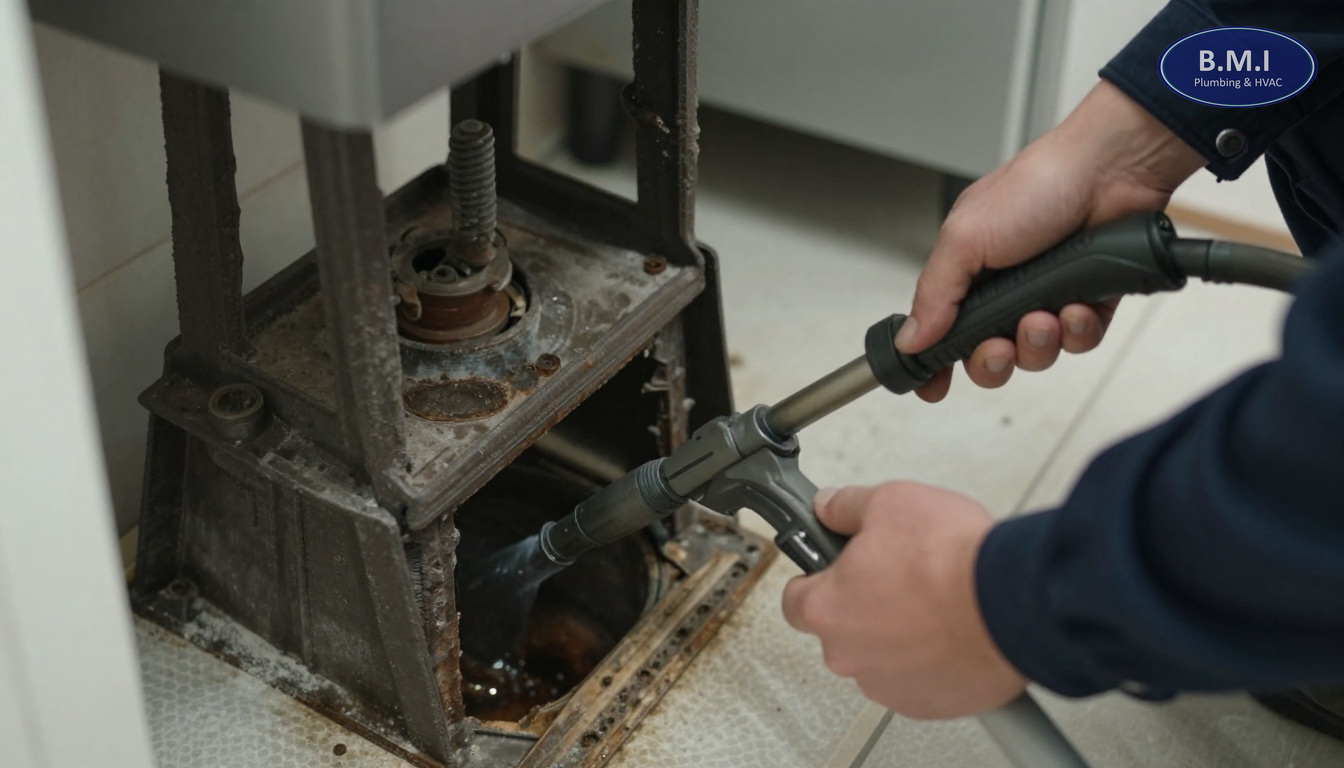
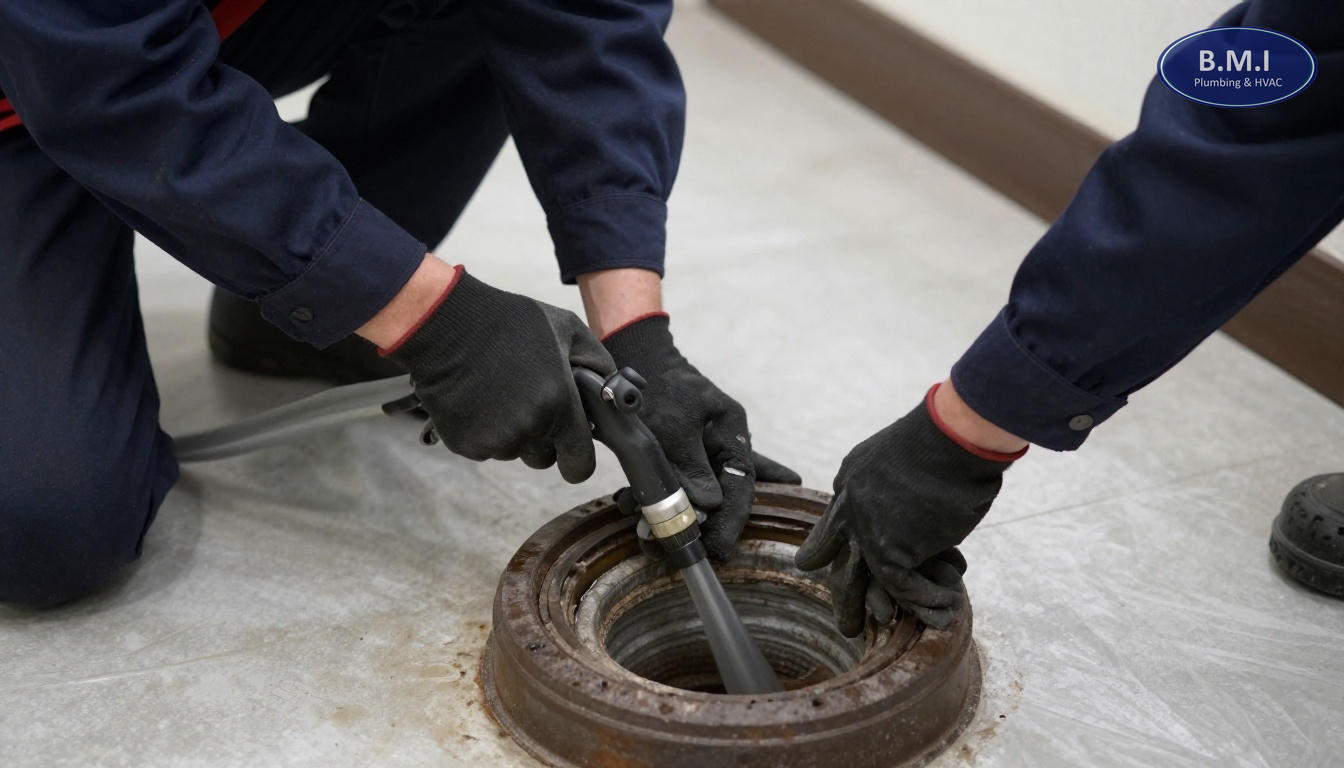
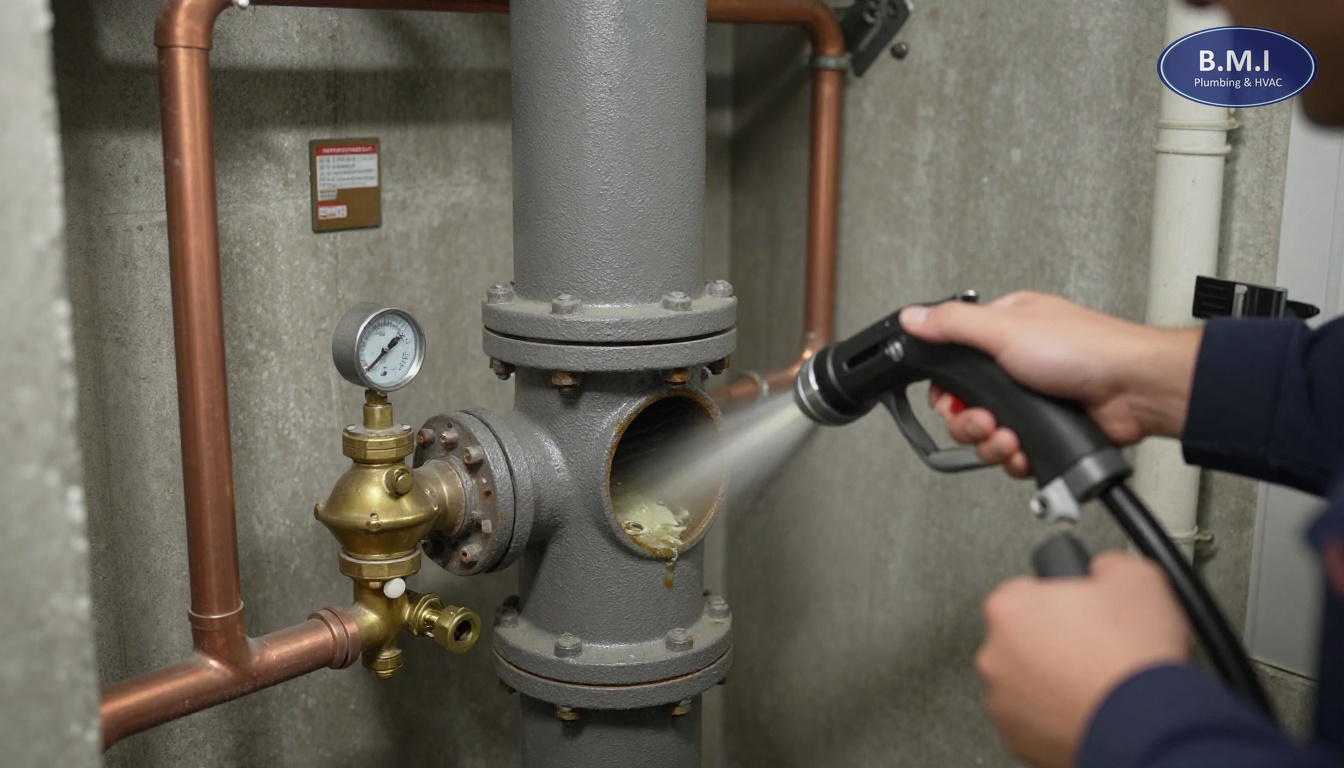
By contrast, high-pressure jetting uses water under controlled pressure through a hose and nozzle to scour the wall of the stack. On a properly set up kitchen stack cleaning program, the goal is not simply to get water moving today. The goal is to recover as much of the original inside diameter as the pipe condition will allow and to remove the material that causes the next call.
There is also a political reason boards should understand the distinction. If management reports to the board that “the stack was cleaned” when it was actually only snaked from one suite or one basement cleanout, that can create a false sense that preventive maintenance was done. It was not.
What is actually happening inside a condo waste stack
Most high-rise kitchen stacks in Toronto, Scarborough and Etobicoke built in the 1970s and 1980s are cast iron, commonly 3-inch or 4-inch vertical stacks with branch connections from each suite. The inside wall of aging cast iron becomes rough, and that roughness is not cosmetic. It gives grease and food solids something to hold onto. Once the pipe loses its smooth interior, buildup accelerates, especially where there are offsets, long horizontal runs at the base, or partial back-pitch from settlement or hanger issues.
A non-expert often assumes grease only matters in restaurants. In condominium towers, the real loading comes from hundreds of small discharges: pan washings, emulsified fats from dish soap, rice and pasta starch, coffee grounds, and dishwasher cycles that dump warm, particle-laden water into a cooler stack. In post-2010 glass towers in Vaughan and Markham, the pipe material may be newer no-hub cast iron or plastic in parts of the system, but kitchen waste still loads up if the stack serves many suites and the cleaning interval is too long.
Another detail that matters is stack geometry. A vertical stack can appear to drain acceptably even when the lower 10 to 20 feet near the base is heavily restricted. That is why managers get complaints from lower floors first. The upper floors discharge into a partially blocked base, and the pressure head from above forces wastewater to seek relief through the lowest branch openings. This is also why a resident may insist, in good faith, that “my sink is the problem” when the evidence points to the common stack.
If the system is domestic waste rather than storm or sanitary combined piping, the branch sizes are usually smaller than residents expect. A kitchen branch may be 1 1/2-inch or 2-inch, while the stack is 3-inch or 4-inch. Snaking a small branch line can clear a local obstruction, but it does very little for a vertical stack whose wall is narrowed by a 1/2-inch ring of grease all the way around. Losing 1/2 inch of radius in a 3-inch pipe has a much bigger impact on flow area than most people realize.
How the symptoms present in a building
The most useful diagnosis starts with the complaint pattern, not the tool. A single suite with a slow drain that improves after trap cleaning may be an in-suite branch issue. But a kitchen sink that drains normally on its own and then backs up when the suite above runs a dishwasher is a different story. That points upstream to a shared stack condition, not a private fixture problem.
In buildings we service in Toronto and East York, there are several repeat symptom patterns that strongly suggest hydro jetting vs snaking is the real decision:
- Repeated backups in the same vertical line over 3 to 12 months, often affecting 2 to 5 floors.
- Lower-floor kitchen sink backups during peak meal periods, especially evenings, weekends and holidays.
- Temporary improvement after snaking, followed by recurrence after heavy dishwasher use.
- Gurgling at one fixture when another suite discharges, which can indicate restricted stack flow or venting issues.
- Basement or parking-level cleanout discharge when the stack base is loaded with grease and solids.
A common mistake we see in early-1990s North York high-rises is treating these signs as proof that residents are misusing drains. Misuse is part of the picture, but it is rarely the full explanation once a stack has aged. When the pipe wall becomes rough enough, normal residential use is enough to keep feeding the problem.
This is one reason a scheduled maintenance program usually costs less than repeated reactive service. A building that spends $500 here and $700 there on emergency drain calls can easily exceed the cost of proper annual stack jetting while still carrying the resident frustration and flood risk.
What snaking does well, and where it falls short
Snaking has a proper place in condominium plumbing. Through drain cleaning, a cable machine can be the fastest and least disruptive way to restore flow when there is a localized obstruction. That may include a rag, dense food mass, scale fragment, or a blockage in a branch line where a jetter setup is impractical.
Where snaking is the right tool
Snaking is often appropriate when:
- The blockage appears to be localized to one branch or one fixture group.
- There is a hard obstruction rather than wall-to-wall grease buildup.
- Access is limited and the immediate goal is to restore service quickly.
- The line condition is uncertain and aggressive cleaning should wait for a camera inspection.
In a straightforward emergency, a snake may reopen a line in under an hour. For a resident with an active sink backup, that matters. It is also usually the first-line response after hours, especially when a building needs flow restored before a broader plan can be made.
Where snaking disappoints boards
The issue is not that snaking fails. The issue is that it often succeeds at the wrong objective. A cable head bores through the middle of the blockage. It may retrieve some debris, and it may knock loose a few deposits, but it does not uniformly clean the pipe wall over 10, 20 or 25 storeys.
On a 300-unit building we would expect repeated snaking of kitchen stacks to become a poor-value strategy once the same stack has required more than two or three calls in a year. At that point, management should ask for evidence: what was removed, how far was the cable run, and was there camera confirmation of the remaining condition. If the answer is vague, the board is not really buying maintenance. It is buying temporary relief.
Another limitation is that snaking can leave behind an uneven interior profile. That roughened residue becomes a fast reattachment surface for grease. In other words, the line may be technically open but hydraulically still poor.
What hydro jetting actually accomplishes in a condo stack
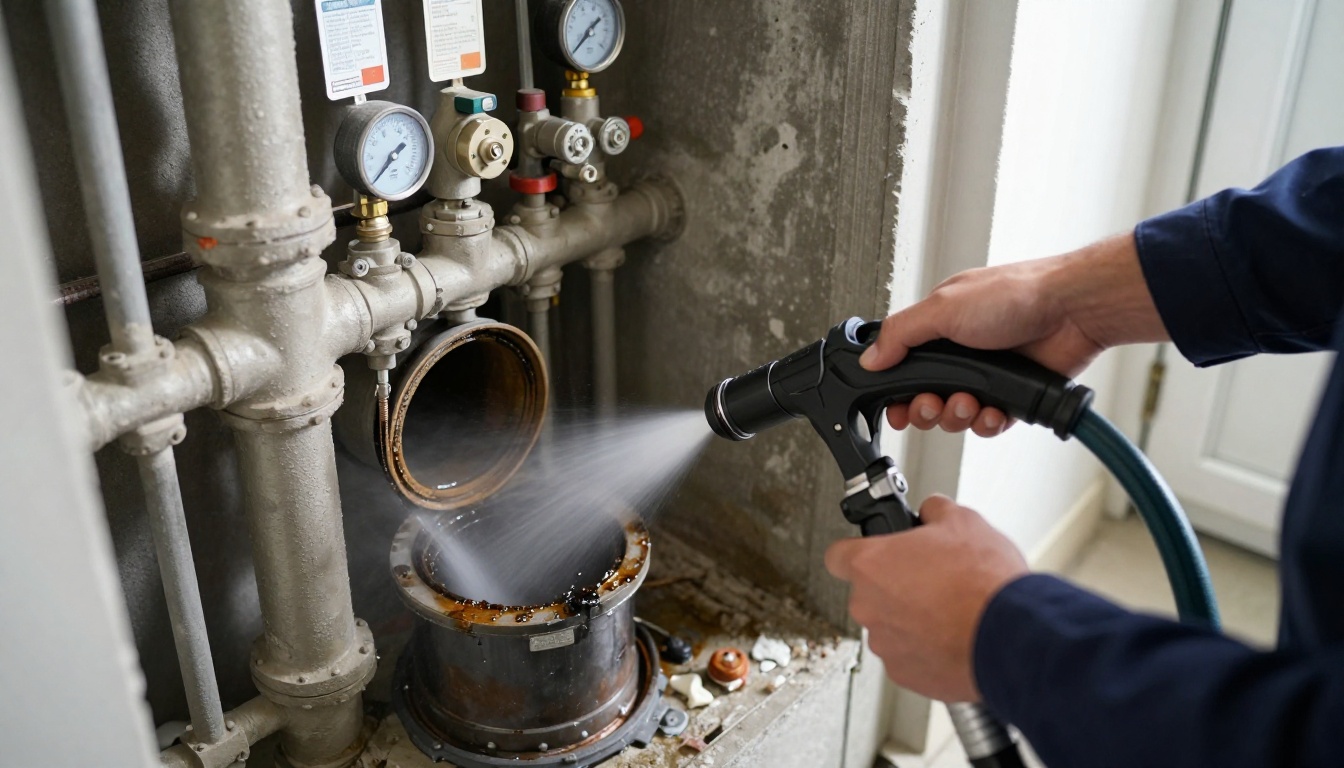
Hydro jetting uses pressurized water, often with specialized nozzles that direct jets rearward for propulsion and outward for cleaning. In condominium stack work, the setup is more controlled than many readers expect. The pressure and flow have to suit the pipe material, diameter, access point and condition. This is not simply “more force is better.”
In planned kitchen stack cleaning, the purpose is to remove grease film, soap deposits and loose scale from the wall of the pipe. In a typical 3-inch or 4-inch kitchen stack, the best result comes when the contractor works from proper cleanout locations and understands where the stack offsets, where the base turns horizontal, and where recurring restrictions usually sit.
Why jetting works better on grease-loaded stacks
Water jets clean the full interior circumference rather than one narrow path. That matters because grease accumulation is usually annular; it forms a ring. Once that ring is stripped back, the stack regains carrying capacity and self-scouring improves. The practical result is fewer callbacks and a longer interval before the next cleaning cycle.
In Toronto waterfront buildings and some Mississauga towers with high dishwasher use, the difference after jetting is often visible on camera: what looked like a 4-inch stack behaving like a 2-inch line starts acting like a stack again. The building notices it not because residents compliment the drains, but because the complaint pattern disappears.
Jetting is still not a cure-all
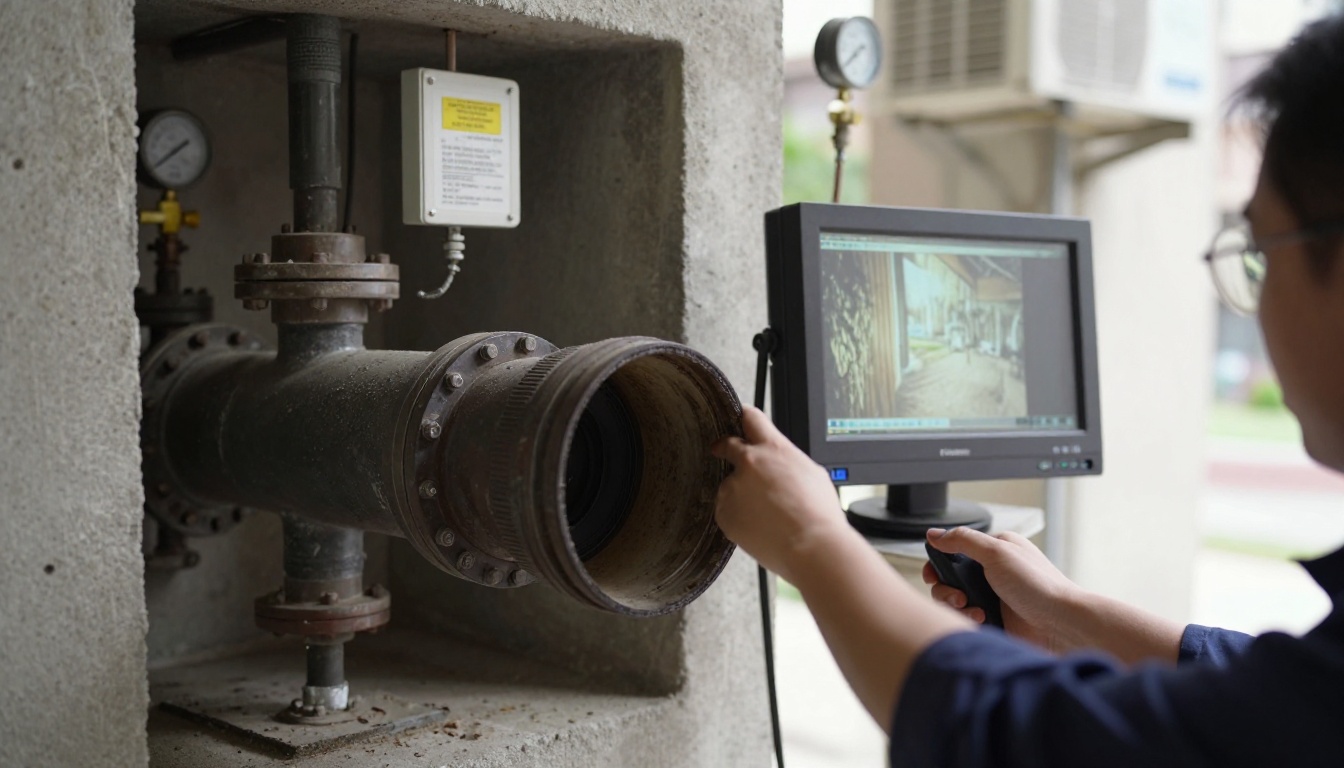
Jetting cannot fix structural defects. If the stack has a belly in a horizontal section, a separated joint, severe tuberculation, or a cracked cast iron base fitting, cleaning may only buy time. That is why a post-cleaning camera inspection is so valuable. Boards should insist on knowing whether they are looking at a maintainable pipe or a capital project candidate.
There is also a common misconception that jetting is only for emergencies. In multi-residential work, the better use is preventive. Fall is often the right time to do it because boards are budgeting for the next year, residents are back from summer travel, and you want the stacks cleaned before the heaviest holiday kitchen loading begins.
What evidence a property manager should ask for
A manager authorizing stack cleaning should ask for more than a service ticket that says “line cleared.” Whether the work is done under repairs and service or a scheduled maintenance plan, the documentation should let management defend the expense to the board and, if needed, to owners.
Ask for these items:
- The stack identification: which vertical line, which suites, and which cleanout locations were used.
- The method used: snake, jetter, or both.
- Pipe type and size if known: for example, 4-inch cast iron kitchen stack.
- Observed condition: grease-loaded, partial blockage at base offset, heavy scale, foreign object, etc.
- Camera footage or stills where appropriate, especially if repeat work is being recommended.
- A recommended interval for next cleaning based on actual condition, not a generic annual suggestion.
If a contractor recommends repeated snaking without explaining why jetting is unnecessary, get a second opinion. Conversely, if someone recommends jetting every waste line in the building without identifying which stacks are actually loading up, that also deserves scrutiny. Good advice is targeted.
A useful companion service is a valve audit before planned cleaning programs that may involve isolations or access in older service areas. Many 1970s and 1980s buildings discover during maintenance that the valve records are incomplete or the isolation points are not dependable. That becomes a bigger issue on larger projects, but even routine maintenance goes more smoothly when the building knows what can and cannot be shut down.
Repair, maintenance or replacement: a decision framework
The right question is not “jet or snake” in isolation. The right question is what stage the stack is in.
| Stack condition | Typical symptoms | Best approach | What to watch for |
|---|---|---|---|
| Localized blockage in one branch | One suite affected, sudden stoppage, no pattern in vertical line | Snaking first | Confirm it is not a recurring common stack issue |
| Grease-coated but structurally serviceable stack | Repeat kitchen backups, lower-floor issues, temporary relief after snaking | Hydro jetting program | Set interval based on camera evidence |
| Mixed condition with offsets or damaged base fittings | Frequent recurrence despite cleaning | Jetting plus camera inspection and targeted repair | Budget for sectional replacement |
| End-of-life cast iron or repeated failures in multiple stacks | Cracks, leaks, chronic restrictions, poor wall thickness | Capital planning for building re-piping or stack replacement | Reserve fund timing and access logistics |
For domestic water systems, the maintenance-versus-replacement discussion often leads to riser replacement or valve replacement. Waste stacks are no different conceptually. There is a point where cleaning remains sensible, and a point where it becomes a way of postponing a capital item that the reserve fund should start planning for.
A practical threshold: if the same stack needs emergency attendance several times a year and camera work shows severe internal deterioration, management should stop calling it maintenance. It is now a budgeting issue.
Toronto-market cost ranges boards can actually use
These are broad GTA market ranges, not BMI quotations, and they vary by building height, access, after-hours requirements, cleanout condition and how many stacks are bundled into one mobilization. Still, boards need numbers early, especially in fall budget season.
Typical cost ranges
| Service item | Typical GTA range | How it is usually priced |
|---|---|---|
| Emergency snaking of a localized waste blockage | $350-$900 | Per call, higher after hours or if multiple access points are needed |
| Snaking with minor follow-up or repeated attendance | $700-$1,500 | Per incident or per stack depending on scope |
| Planned hydro jetting of one kitchen stack | $900-$2,500 | Per stack, depending on height and access |
| Camera inspection after cleaning | $350-$1,200 | Per stack or per visit |
| Multi-stack annual program in a mid/high-rise | $5,000-$30,000+ | Per building, depending on number of stacks and complexity |
A 20-storey building with 8 to 12 kitchen stacks can see a significant difference between reactive and planned spending. If each recurring stack generates two emergency calls a year at $600 to $1,000 per call, the annual reactive cost can rival a planned kitchen stack cleaning program without reducing flood risk.
There are also hidden costs that do not appear on the plumbing invoice:
- after-hours concierge time
- resident complaint handling
- restoration to ceilings or cabinetry if backups escape containment
- insurance deductibles and chargeback disputes
- board time spent arguing about responsibility
For some corporations, the better financial comparison is not snake versus jet. It is emergency operating expense versus planned maintenance plus reduced claim exposure.
Timelines, access and resident logistics
One reason boards defer stack cleaning is the assumption that it is highly disruptive. It can be, but usually less than repeated emergency calls.
For a planned program, a crew may complete several stacks in a day depending on building layout, cleanout access and whether suite entry is required. A straightforward stack jetting from accessible cleanouts can be relatively efficient; a building with poor access, hidden cleanouts or suites that have enclosed service spaces will move more slowly.
Typical logistics include:
- Resident notice of at least 48 to 72 hours for planned access, often longer under management policy.
- Coordination with the building operator for service room access and any housekeeping protection.
- Possible suite entry if branch access or confirmation is needed.
- Temporary advice to residents not to discharge kitchen fixtures during the work window.
- Elevator booking and protection if equipment must move through finished common areas.
This is where a broader building review can help. If the same building is also due for PRV maintenance, backflow prevention testing, or planned valve replacement, fall is often the right season to line up those scopes and present one coordinated maintenance plan to the board.
For active backups, response is different. An emergency plumbing response is about immediate containment and reopening flow. But after the emergency, management should decide whether that call was an isolated event or evidence that the stack belongs in a scheduled program.
What happens if you defer the right cleaning method
Deferral has a predictable pattern. First the line needs more frequent emergency attendance. Then lower floors start complaining that the issue is “always our line.” Then management spends time on owner-versus-corporation responsibility disputes. Finally, one backup causes enough damage that the conversation becomes about insurance rather than maintenance.
In Ontario condominium practice, that matters because the plumbing diagnosis can influence who pays. The declaration and standard unit definition govern responsibility, but common element versus in-suite is often the key distinction. A vertical stack is commonly a common element; a trap, tailpiece or fixture connection in the suite may be unit responsibility. If management misdiagnoses a common stack condition as a suite issue, chargebacks can become difficult to defend.
There is also reserve fund context. Repeated stack problems do not automatically mean immediate replacement, but they should be documented for the next reserve fund study update or Class 1/2/3 review cycle. A written record showing frequency, cleaning results and camera findings helps consultants decide whether the building is dealing with maintainable cast iron or a looming replacement scope.
Deferral can also affect adjacent systems. During the same fall planning window, many boards are reviewing project solutions such as risers, expansion compensators, or even Kitec replacement in applicable buildings. Waste stack maintenance should be on that same planning calendar, not treated as a nuisance item until it floods a suite.
A practical recommendation for fall budget season
If your building has had more than one kitchen stack backup in the same vertical line in the past 12 months, do not simply approve another generic drain call. Ask whether the previous work was snaking or actual wall-cleaning jetting, and ask for evidence.
For many Toronto, Vaughan and Mississauga condominiums, the sensible fall plan is:
- Identify repeat-problem stacks from service history.
- Perform targeted hydro jetting on those stacks.
- Camera-check representative lines where recurrence has been high.
- Set a cleaning interval of 12, 18 or 24 months based on actual condition.
- Budget next year accordingly rather than waiting for holiday-period backups.
That is a more defensible board recommendation than either extreme. It avoids overspending on blanket work without evidence, and it avoids the false economy of repeated snaking where jetting is clearly required.
If a building has not reviewed its broader plumbing maintenance in some time, start with the service history and compare it against the available BMI project references and completed work and other BMI articles on condominium systems. The pattern usually becomes obvious once the repeat calls are lined up by stack.
FAQs
Is hydro jetting always better than snaking for a condominium waste stack?
No. Hydro jetting and snaking solve different problems. A cable snake is often the right first response for a localized blockage, especially when one branch line or one section of stack is obstructed by a hard object, while jetting is the better maintenance method when a 3-inch or 4-inch kitchen stack is coated with grease and soap scale along many floors.
How often should a condo corporation jet kitchen stacks?
In many Toronto high-rises, kitchen stack cleaning on a 12- to 24-month cycle is reasonable, but the correct interval depends on use, pipe age and what the camera shows afterward. Buildings with heavy dishwasher use, short horizontal offsets, and older cast iron stacks from the 1970s or 1980s often need annual or 18-month cleaning, while some newer mid-rises can go closer to 24 or even 36 months if the stack stays open and smooth.
What does snaking actually remove from a stack?
Snaking usually punches a hole through a blockage or pulls back a limited amount of debris; it does not typically restore the full inside diameter of the pipe. In a grease-loaded kitchen stack, a snake may reopen flow for a few days or weeks while leaving a thick ring of buildup on the wall, which is why the same suites often call back after the next heavy cooking period.
Can jetting damage old cast iron piping?
It can if it is done carelessly, which is why the method, nozzle and pressure need to match the pipe condition. In older Toronto, East York and Scarborough buildings with heavily scaled cast iron, a contractor should confirm the pipe is structurally serviceable by experience, access points and, where needed, a camera inspection before aggressive cleaning; if the barrel is already paper-thin or cracked, the issue may be replacement rather than maintenance.
What does waste stack cleaning usually cost in Toronto?
As a broad market range, a planned high-pressure jetting program for a condominium kitchen stack can run roughly $900 to $2,500 per stack depending on height, access, cleanout condition and how many suites require entry. Emergency snaking of an active blockage is usually priced differently, often $350 to $900 for a straightforward call and more if multiple visits, after-hours work, ceiling openings or camera work are required.
Who pays when one suite has a backup but the stack is the real problem?
In many condominiums, the answer depends on the declaration and standard unit definition, but a vertical waste stack is commonly a common element even when the backup shows up at one sink. A useful rule of thumb is that if the sink drains on its own but backs up when an upper suite discharges a dishwasher or kitchen sink, the corporation should look at the stack before charging the owner for an in-suite problem.
Next steps for a property manager or board
If your building has recurring kitchen sink backups and the service history just says “drain cleared,” you do not yet have enough information to budget properly. Ask for the stack numbers, the method used, and whether the contractor is recommending snaking for a blockage or jetting for actual stack cleaning.
If your kitchen stacks have not been jetted in over two years, or if the same vertical line has needed multiple emergency calls, arrange a site review before finalizing next year’s maintenance budget. BMI attends the building before quoting, and where it makes sense, maintenance programs are set up on a schedule rather than sold call by call. For active backups or leak events, 24/7 emergency plumbing response is also available.
For planned stack cleaning, camera review, or a building-specific recommendation on hydro jetting vs snaking, request a site visit through BMI’s contact page or ask for a review of your recent service history.
Contact BMI
- Contact BMI
- Phone: (416) 845-3756
- Emergency: (416) 845-3756, answered 24 hours a day
- Email: info@brial.ca
More on condominium plumbing
Condo Kitchen Stack Cleaning Frequency in Toronto
How often should a condo kitchen stack be cleaned? Toronto guidance on stack cleaning schedule, costs, warning signs and …
Why Kitchen Stacks Block in Toronto Condominiums
A practical guide to kitchen stack cleaning in Toronto condos: why grease buildup happens, what blockage signs mean, and …
In-Suite Plumbing Repairs in Whitby Condominiums
Practical guidance on in-suite plumbing repairs in Whitby condominiums, including diagnosis, costs, timelines, and …
Need a plumber in your building?
BMI services roughly 200 condominium and multi-residential buildings across Toronto and the GTA. Emergencies are answered at any hour.