
Stack Cleanout Access in Toronto Condos: What Gets Buried
Stack cleanout access problems in Toronto condos often start with renovations. Learn how hidden cleanouts affect drain service, costs, chargebacks and planning.
Stack Cleanout Access in Toronto Condos: What Gets Buried
Quick summary: In many Toronto condominium buildings, the cleanout is not missing. It is still there, but twenty years of bathroom renovations, custom kitchens, flooring changes and built-ins have buried it behind finishes that were never supposed to become permanent. That matters because stack cleanout access is what turns a controlled maintenance call into a simple one-hour service instead of an after-hours backup, a damaged suite, and a dispute over who pays.
A common mistake boards make in budget season is treating drain backups as a cleaning problem only. In practice, the building may already have a reasonable kitchen stack cleaning program, but if the contractor cannot reach the right condo cleanout, the stack cannot be properly serviced. Fall is the right time to find this out, before holiday cooking loads hit kitchen stacks and before winter emergency access becomes more expensive.
The real problem is not the blockage. It is the missing route to the blockage.
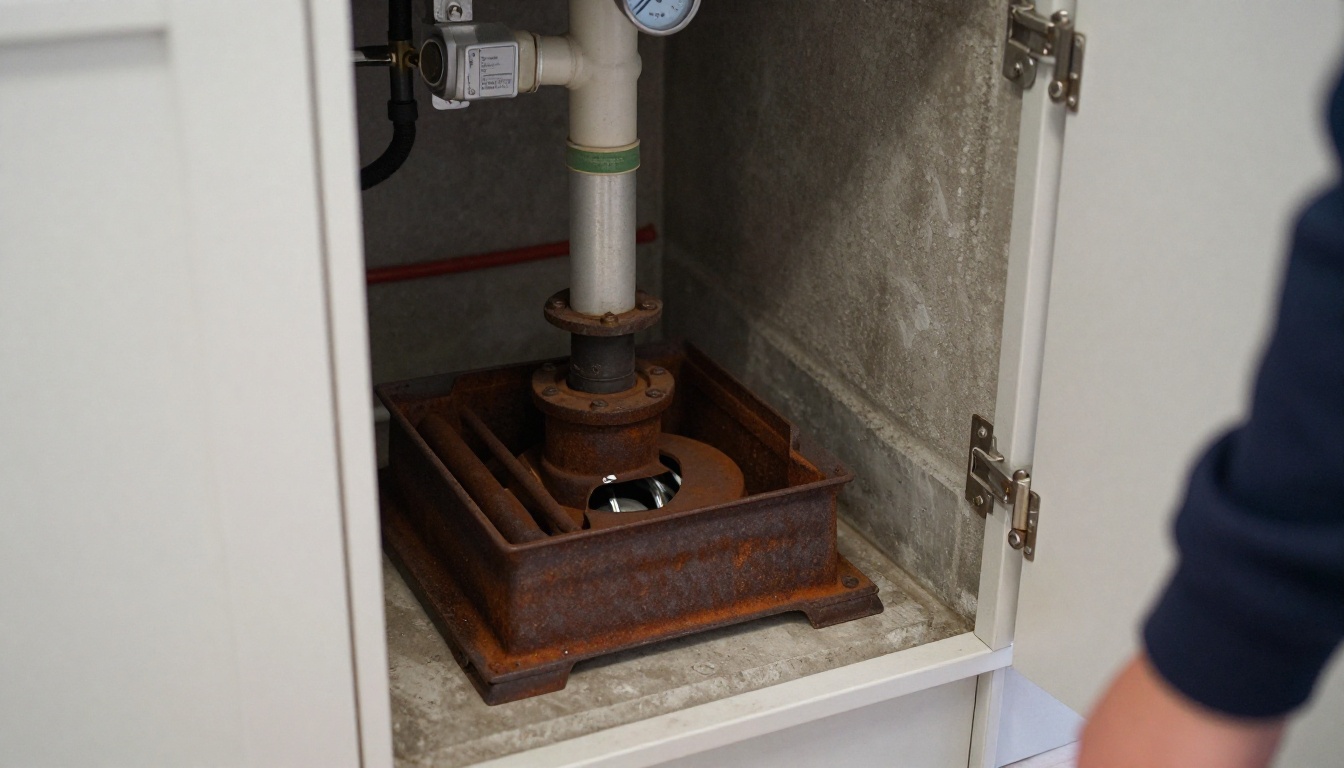
In older Toronto high-rises, especially 1970s and 1980s concrete towers in North York and Etobicoke, the original plumber usually left cleanout access in practical but visually awkward places: the back wall of a vanity, a drywall bulkhead, a laundry closet, the side of a kitchen sink cabinet, or a corridor access panel. Those locations made sense because a 3-inch or 4-inch cast iron stack needs a straight or near-straight point of entry if you want to rod or jet it effectively. Once suites were renovated, those panels often disappeared behind tile, quartz, melamine cabinetry or mirrored millwork.
That creates a predictable pattern. The first contractor arrives for a backup, opens the sink trap, snakes from the fixture arm, gets partial flow, and leaves. A month later the same line backs up when the suite above runs a dishwasher. At that point the issue is no longer really “a sink clog”. It is a stack maintenance problem with compromised access, and the building should be thinking about camera inspection and access restoration, not just another service call.
One useful test for managers: if a kitchen sink drains reasonably on its own but backs up when another suite discharges, that usually points toward the shared vertical stack or branch, not the in-suite fixture alone. That distinction matters because it often shifts the conversation from owner responsibility to common element investigation.
Why cleanouts get buried in condo buildings
The short answer is renovations. The more useful answer is that cleanouts are often buried because nobody involved in the renovation understood what they were looking at.
In buildings we service across Toronto, Vaughan and Mississauga, the most common scenarios are:
- A bathroom access panel is removed during tile work and the wall is closed permanently.
- A kitchen cabinet run is extended over a sidewall cleanout because the cabinet installer assumes it is abandoned.
- A stacked laundry closet gets rebuilt with shelving and no service opening.
- A bulkhead is dropped to hide piping or ductwork and covers a cleanout tee on a horizontal branch.
- An owner alteration approved years ago never made it back into the corporation’s records, so operations staff do not know access was lost.
There is also a building-age pattern. In early-1990s towers in Scarborough and Markham, it is common to find no-hub cast iron sanitary stacks with cleanouts located just above finished floor level behind vanity toe kicks or in shallow service chases. In post-2010 glass towers, the issue is less often cast iron stack access and more often millwork blocking isolation points or access doors being made too small to work through safely. Different vintage, same result: the pipe is there, but the service path is not.
Another non-obvious issue is that some cleanouts were never designed for repeated use after decorative finishes were added. A threaded brass or cast iron cleanout plug that has not been touched in 20 years may seize in place. So even when the access opening exists, the fitting itself may fail when opened. That is one reason a planned drain cleaning visit in the fall is cheaper than discovering the same problem during a Saturday night backup.
How this presents in the building office and at the concierge desk
Managers rarely get a report that says, “Our cleanout access strategy has failed.” They get symptoms.
Typical reports include:
- “Unit 1204’s kitchen backed up again after the suite above used the dishwasher.”
- “The plumber said he could not get proper equipment into the line because the access is behind tile.”
- “The same vertical line has had three service calls in six months.”
- “The owner says the problem is common element, but the contractor worked through the sink cabinet.”
- “We have no record of where the stack cleanout actually is.”
The pattern matters more than the individual complaint. On a 250- to 350-unit building, one isolated kitchen blockage can still be suite-specific. Three calls on the same vertical stack in 12 months usually are not. When that happens, the right next step is often a combination of camera pipe inspection and a review of whether the proper cleanout can still be reached.
A second symptom is contractor hesitation. If experienced drain technicians keep noting that access is poor, that is not a soft comment. It usually means the line is being serviced from the wrong point, often through a 1 1/2-inch or 2-inch fixture branch instead of the intended 3-inch stack access. You can sometimes clear a local obstruction that way, but you do not properly descale or degrease a loaded kitchen stack from a small branch opening.
A third symptom shows up in budgeting. Buildings that spend $8,000 to $15,000 a year on repeated reactive drain calls on the same group of stacks often assume they have a cleaning frequency problem. Sometimes they do. But just as often they have an access problem, and no maintenance frequency will fully compensate for bad entry points.
What a proper inspection should include before anyone starts opening walls
Before authorizing destructive work, ask for evidence. A credible diagnosis should not be based on guesswork or on a resident’s memory of a renovation from 2009.
At minimum, the investigation should include:
- A site review of the affected suites and adjacent stack line. If unit 1406 is backing up, look at 1306 and 1506 as well. Stack problems reveal themselves vertically.
- Identification of pipe material and size. A 3-inch no-hub cast iron kitchen stack behaves differently than a 4-inch sanitary stack or a 2-inch branch line.
- Photos of current access conditions. This is critical for owner communication and potential chargebacks.
- Any available camera footage showing grease loading, scale, offsets, standing waste or branch tie-in condition.
- A written recommendation stating whether the immediate need is cleaning, access restoration, fitting replacement, or broader stack rehabilitation.
If the building has not done it already, this is also a good time to pair the review with a valve audit. Many of the same buildings that have buried cleanouts also have untagged or seized isolation valves. That becomes important if access restoration turns into a larger stack or branch repair and you need to know what can actually be isolated.
In practical terms, opening one exploratory area is often enough to avoid opening five unnecessary ones. We have seen buildings assume a cleanout was in the vanity wall because that is where it existed on lower floors, only to find that upper-floor layout changes moved access to a laundry chase. Original drawings help, but they are not always field-accurate after decades of modifications.
Another point worth insisting on: if a contractor says the stack is blocked, ask where the blockage starts relative to the cleanout location. A partial grease choke 8 to 12 feet below the kitchen branch tie-in suggests routine maintenance may have been deferred. A hard obstruction immediately below a buried cleanout may suggest the stack has not been properly serviced in years because nobody could reach it.
Repair, restore access, or redesign the maintenance route?
Not every buried cleanout requires a major opening. The right response depends on how often the stack needs service, the finish condition of the suite, and whether there is another viable access point.
Option 1: Restore the original access
This is usually the best answer when the cleanout is in roughly the right place and the stack has a service history. Installing a properly sized access panel in drywall is straightforward. The panel needs to be large enough for tools and hands, not just large enough to see the fitting. In practice, that often means a 12-inch by 12-inch panel is the bare minimum, and 16-inch by 16-inch is more workable if the fitting is low or tight to framing.
Option 2: Rebuild the cleanout location
If the original fitting is damaged, inaccessible, or too close to finished flooring to be usable, the contractor may recommend replacing the cleanout tee or adding a more serviceable access point during a planned shutdown. That can mean cutting and replacing a section of 3-inch or 4-inch no-hub cast iron with shielded couplings and a new service fitting. If the stack is already thin-walled or heavily scaled, this work starts to overlap with project solutions rather than routine maintenance.
Option 3: Use an alternate service route
Sometimes the building can maintain the line from a lower cleanout in a service room, a corridor chase, or a horizontal branch access point. That can be acceptable if camera footage shows the contractor can reach the problem area consistently. It is less acceptable when the route requires repeated dismantling of in-suite fixtures or when cleaning results have been poor. For kitchen stacks, high-pressure jetting typically performs best when the hose enters at the correct stack cleanout and can work both up and down the line.
Option 4: Fold it into a larger capital plan
If the same line has buried access, failing valves, corroded cast iron and repeated backups, piecemeal work may be false economy. In that case, the building should price the immediate repair but also compare it against broader building re-piping or stack-related renewal planning. Not every problem needs a capital project, but some do, and boards are better served by seeing both numbers.
What this costs in Toronto and the GTA
Costs vary sharply depending on finishes, access, occupancy and whether the fitting itself is usable. The expensive part is often not the plumbing. It is the restoration and coordination.
| Scope | Typical Toronto market range | Notes |
|---|---|---|
| Locate and inspect buried cleanout in occupied suite | $350-$900 per location | Usually non-destructive unless opening is authorized |
| Install drywall access panel | $400-$900 | Best case if fitting is already usable |
| Open and restore tiled or millwork-covered access | $1,500-$4,000 | Finish restoration drives cost |
| Replace seized or damaged cleanout fitting on cast iron | $2,500-$6,000 | Depends on exposure and shutdown complexity |
| Camera inspection of affected stack line | $450-$1,500 | Range depends on access and footage length |
| Planned kitchen stack jetting with proper access | $600-$1,500 per stack | Access issues can increase time materially |
| Repeated reactive emergency calls on one bad stack over a year | $3,000-$10,000+ | Often exceeds planned access restoration |
These are budget ranges, not quotes. In downtown Toronto, Yorkville-adjacent or waterfront towers with premium finishes, restoration can exceed the plumbing cost by a wide margin. In older purpose-built rentals in East York or North York with simpler finishes, the same access restoration may be relatively modest.
One board-level insight: if a buried cleanout sits inside an owner-improved suite with stone, custom cabinetry and specialty tile, the corporation should clarify before work starts whether it is restoring to standard unit condition or to altered finish condition. That is where the declaration and alteration records matter financially.
The operational side: notices, access, shutdowns and resident friction
This is where many otherwise sensible plumbing plans go sideways. The pipe work may be simple, but condominium logistics are not.
For a single access restoration in an occupied suite, expect:
- 48 hours legal minimum entry notice in many cases, but ideally 5 to 10 business days for coordination
- resident confirmation of pets, alarm systems, elevator booking and work hours
- dust control and floor protection because the access point is often in a finished area
- possible follow-up visit if plumbing exposure and finish restoration are split trades
For stack-related work affecting multiple suites, managers should also think vertically. If a cleanout on the 9th floor serves a stack from 2 to 24, the suites above and below may need notice even if they are not being opened that day. A blocked stack is not a local event.
Fall is the best season to deal with this because:
- residents are back from summer and easier to schedule than December
- boards are preparing next year’s operating and reserve budgets
- kitchen stack loading typically increases through late November and December
- emergency contractors are harder to coordinate during holiday periods
This is also a good time to review maintenance programs more broadly. Buildings that plan stack cleaning, PRV review and valve verification together usually have fewer surprise shutdowns in winter than buildings that handle each issue reactively.
Common element or in-suite responsibility: the question everyone asks
This is the part managers need to explain clearly to owners.
A useful framework is:
- The stack and branch serving multiple units are often common elements, but confirm with the declaration.
- The finishes, cabinets, tile or millwork concealing access may be owner responsibility if altered from original condition.
- The immediate cause of the blockage may still matter. Grease abuse by one resident can trigger chargeback conversations, but only if the corporation has evidence and a clear policy.
- Alterations approved under a Section 98 agreement may allocate reinstatement costs differently than standard unit repairs.
The Condominium Act, 1998 does not tell you where every plumbing cost lands. The declaration and standard unit definition do that work in practice. That is why a manager should avoid promising an owner that “the corporation pays” or “the owner pays” until the access issue, original condition and pipe function are all confirmed.
A common mistake we see in Toronto and Vaughan is treating a buried cleanout as if it were only an owner renovation issue. If the corporation knew or should have known that the access point was essential to maintaining a common element stack, allowing it to disappear for years can complicate a simple chargeback position. Documentation matters.
If the suite-level plumbing itself is under review, in-suite plumbing records can help distinguish a local fixture problem from a stack issue. The cleanest decisions come from evidence, not assumptions.
What happens if you defer it another year
Sometimes deferral is reasonable. If a buried cleanout is on a low-risk stack with no service history and no current symptoms, mapping it for future planning may be enough for now. But if the stack is already generating calls, deferral usually costs more than boards expect.
The likely consequences are:
- higher emergency response costs, especially after hours through 24/7 emergency plumbing
- more invasive service from poor access points, with a lower success rate
- increased risk of suite damage when backups are not controlled early
- owner disputes over chargebacks because the corporation never addressed known access limitations
- poor reserve planning because repeated operating costs mask a capital-access problem
On kitchen waste stacks, the timing is especially predictable. A partially restricted cast iron stack that is passable in September can become a December problem once grease, starches and holiday cooking loads increase. The building then discovers, at the worst possible time, that the correct condo cleanout is behind a tiled pantry wall.
There is also an insurance angle. If a corporation has a known repeated-loss location and no documented plan to maintain or access it, that can become an uncomfortable conversation after a backup claim. Insurers are increasingly interested in maintenance history, not just the event itself.
A practical decision framework for boards this fall
If you need to put something in front of the board before next year’s budget is approved, keep it simple.
Budget for investigation first if you do not have facts
If the building cannot say which stacks have accessible cleanouts and which do not, authorize a targeted survey on the worst-performing lines first. Pair it with camera inspection where service history justifies it.
Restore access where the stack already has a service history
If a stack has had 2 or more related service calls in 12 months, restoring access is often cheaper than continuing reactive cleaning from the wrong point.
Coordinate with other maintenance work
If the building is already scheduling kitchen stack cleaning, PRV maintenance or a valve replacement review this fall, add cleanout mapping to the same planning cycle. Buildings save money when site visits answer multiple questions at once.
Keep records for future chargebacks and reserve planning
Photograph the concealed condition, record the suite number, note whether the finish appears altered, and retain the written recommendation. That one file often becomes the basis for a chargeback, a board memo and next year’s capital note.
If you want a sense of how these issues fit into broader building planning, BMI’s completed project portfolio and building references and the articles on the BMI blog are worth reviewing before tendering larger work.
FAQs
Who is usually responsible when a stack cleanout has been covered during a suite renovation?
In a condominium, the answer usually depends on the declaration, standard unit definition and whether the cleanout serves a common element stack. In many Toronto buildings, the stack itself is a common element, but an owner who tiled over, drywalled over or built millwork across an access point may still be responsible for the cost to restore access under the corporation’s alteration rules or a Section 98 agreement. The practical step is to confirm the original condition from turnover drawings, renovation records and a site inspection before deciding on chargeback.
Can a drain contractor clean a kitchen stack without using the cleanout?
Sometimes, but it is usually slower, dirtier and less thorough. A technician may work from a sink line, roof vent or a removed fixture, but on a 3-inch or 4-inch cast iron kitchen stack that method rarely gives the same control as proper access at the cleanout, especially if grease has reduced the pipe bore by 50 percent or more. In a high-rise, the difference can be the job taking 1 to 2 hours with proper access versus repeated service calls and incomplete cleaning.
What does it cost to re-establish access to a buried condo cleanout in Toronto?
A straightforward access panel installation in drywall may run about $400 to $900 per location, while opening and restoring tiled millwork or stone-backed finishes can easily land between $1,500 and $4,000 once carpentry, tile and painting are included. If the cleanout fitting itself is damaged, frozen, cracked or needs replacement on cast iron, costs can rise to roughly $2,500 to $6,000 per location depending on exposure, pipe condition and whether after-hours shutdowns are required. Those are market ranges in Toronto and the GTA, not fixed prices.
How much notice do residents need if access has to be opened in occupied suites?
For planned work, most corporations give at least 48 hours written entry notice, but in practice 5 to 10 business days is better when a contractor, resident, concierge and elevator booking all have to line up. If the work affects water use or requires a stack to be taken out of service, managers should also notify the suites above and below because one inaccessible cleanout often points to a stack-wide maintenance issue. Emergency access after a backup is different and is usually handled under the corporation’s emergency entry provisions.
Why does this issue show up so often in older Toronto high-rises?
Because many 1970s to early-1990s buildings were designed with cleanouts in bulkheads, vanity chases, laundry closets or behind removable panels that looked temporary when the building was new. Twenty years later, a sequence of kitchen and bathroom renovations in Toronto, Scarborough and Mississauga often leaves those same points hidden behind custom cabinets, slab backsplashes or tiled walls. The stack did not move, but the route to service it disappeared.
Should a board budget to uncover every hidden cleanout proactively?
Not always. On a building with a stable service history, it can be more sensible to map and prioritize the buried cleanouts on the worst-performing kitchen and laundry stacks first, then coordinate access restoration when suites turn over or when stack cleaning is scheduled. A full building program makes sense when repeated backups, poor valve records and missing cleanout access are all showing up together, because that combination usually means emergency drain costs will exceed planned work within 1 to 3 years.
Next steps for property managers and boards
If your building has had repeated drain calls on the same vertical line, ask a more useful question than “Do we need another snake?” Ask whether the contractor is reaching the stack through the correct cleanout access at all.
For fall planning, a sensible sequence is:
- Identify the 3 to 5 worst-performing stack lines from the last 12 to 24 months.
- Confirm where the intended cleanouts are and whether they are accessible.
- Use camera inspection on the lines with repeated history.
- Price access restoration before holiday loading increases.
- Roll the findings into next year’s operating or reserve discussion, depending on scope.
BMI attends the building before quoting because buried access problems are rarely priced accurately from photos alone. If your kitchen stacks have not been properly reviewed in over two years, or if a contractor has already told you the cleanout is hidden, this is the right time to deal with it before winter and before December service calls start stacking up.
For planned maintenance, stack cleaning and access reviews are best handled on a schedule rather than call by call. If the issue is already active or a backup has occurred, request a quote or service visit and treat it as a building systems problem, not just a suite complaint.
Contact BMI
- Contact BMI
- Phone: (416) 845-3756
- Emergency: (416) 845-3756, answered 24 hours a day
- Email: info@brial.ca
More on condominium plumbing
Sanitary vs Storm Stack Failures in Toronto Condos
How to tell whether a sanitary stack or storm drain condo issue failed, what evidence to demand, Toronto cost ranges, …
Condo Garbage Disposal Rules in Toronto Buildings
Why condo garbage disposal bans are common in Toronto: stack loading, plumbing risk, costs, rule enforcement and what …
Cast Iron Stack Replacement in Toronto Condos at 50 Years
When aging cast iron stacks need cleaning, lining or replacement in Toronto condos, here is how to diagnose, budget and …
Need a plumber in your building?
BMI services roughly 200 condominium and multi-residential buildings across Toronto and the GTA. Emergencies are answered at any hour.