Backflow Prevention Testing & Certification
The City requires backflow devices to be surveyed, tested annually and reported. We test, repair what fails on the same visit, and file the certification so nobody has to chase it.
The only thing separating two water systems is one mechanical assembly
A residential high-rise holds a great deal of water that nobody should drink. The heating loop carries treatment chemicals. Irrigation lines sit in the ground. A cooling tower, a garage wash bay, a pool and the janitorial hose connections each hold water that has been somewhere. Every one of those systems is fed from the same potable supply that serves the suites.
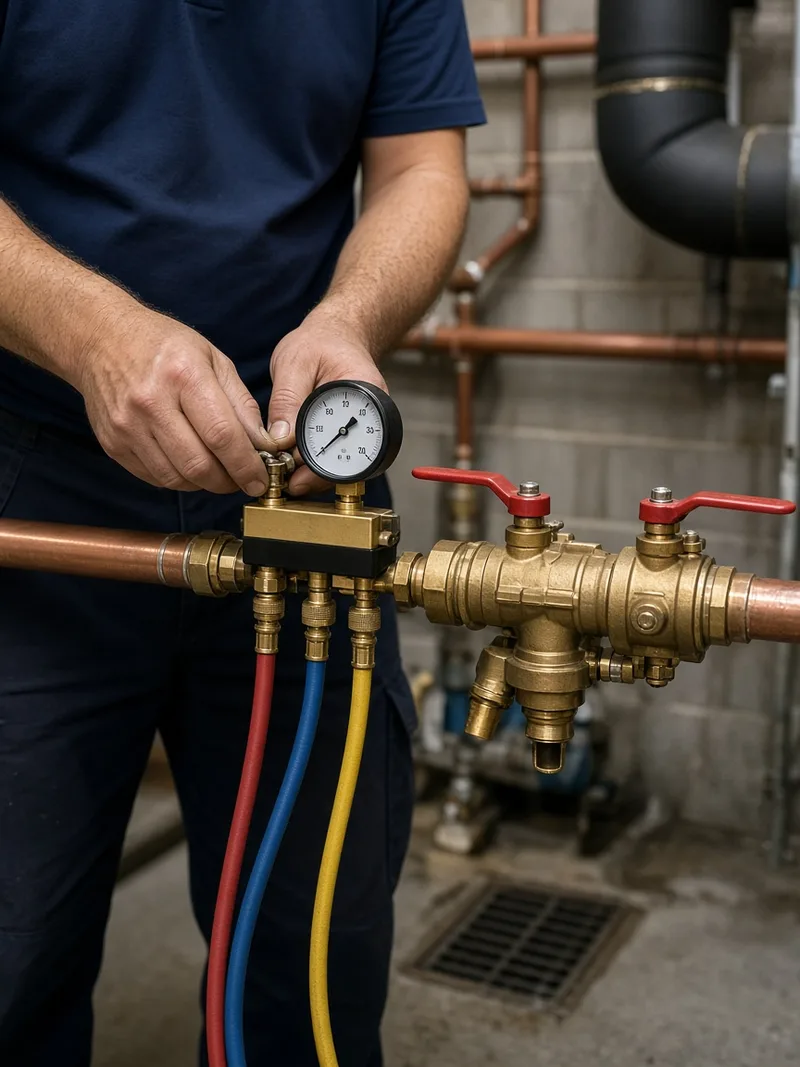
What keeps the two apart is a backflow preventer, and it is a mechanical device with rubber seats and springs inside it. It wears. It fouls. It can fail without any outward sign, and nothing about the building's operation will indicate that it has. Annual testing exists because a device that has failed silently offers exactly the same protection as no device at all.
A compliance item with a real failure mode
Testing is often treated as paperwork, and the by-law framing encourages that. The engineering reality is more direct: in a building with booster pumps, an elevated heating circuit and a municipal supply that occasionally loses pressure, both backflow mechanisms are routinely present. The protection is not theoretical, and neither is its deterioration.
Signs a building's backflow protection needs attention
Most of these are found during a survey rather than reported, which is why buildings that have never had one tend to accumulate several.
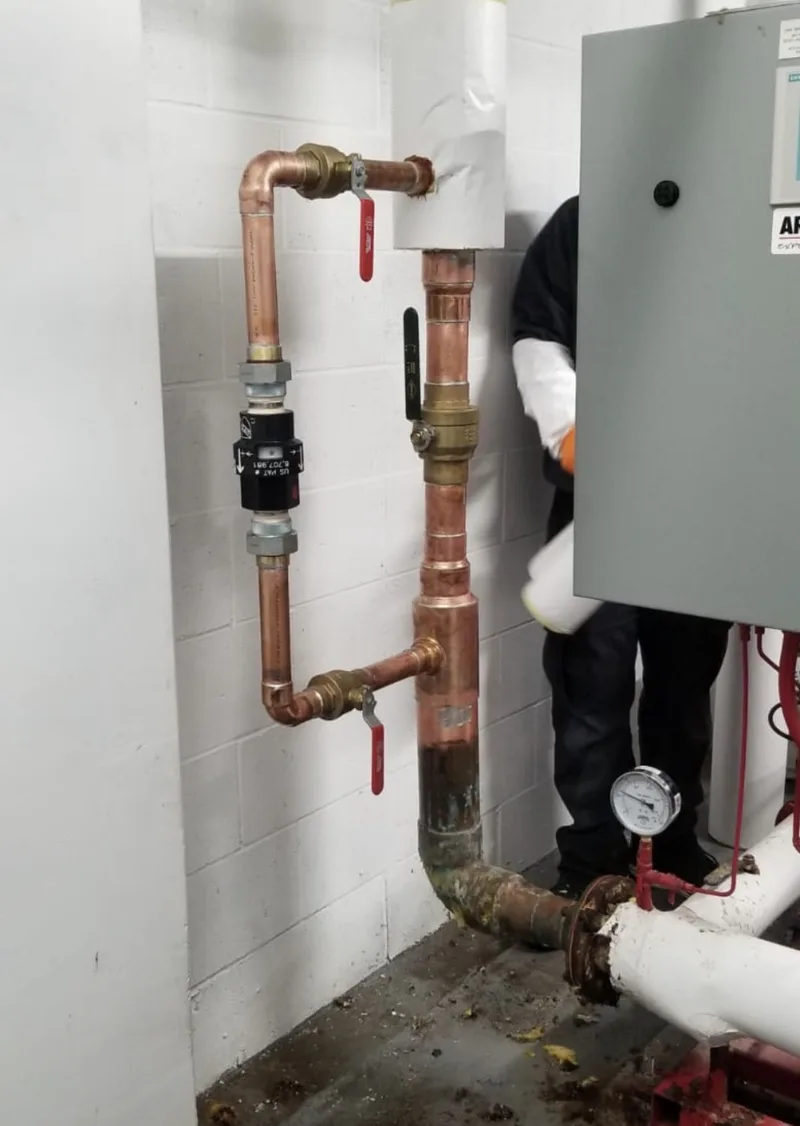
The relief port is discharging
Continuous or repeated discharge from beneath a reduced pressure assembly is the device reporting a failed check valve.
No test on record this year
If nobody can produce the last certificate, the building is almost certainly overdue rather than simply disorganised.
No cross-connection survey
Devices cannot be tested if nobody has identified them, and connections cannot be protected if nobody has found them.
The relief has been capped or piped in
A plugged relief port, or one connected directly into a drain, defeats the safety function the assembly exists to provide.
The wrong device for the hazard
A double check assembly on a severe hazard connection passes its own test and still provides inadequate protection.
New equipment since the last survey
An added irrigation system, a boiler replacement or a new wash bay each create a connection that was never assessed.
Two ways water travels the wrong direction
How we survey, test and certify
Seven stages. The survey comes first, because a building cannot test its way to protection it never installed.
-
Survey the building for cross-connections
Before anything is tested we establish what devices exist and what they protect. Premise isolation at the incoming main, and in-premise protection at the boiler and heating make-up, the irrigation system, the cooling tower, the garage wash bay, the pool and the janitorial sinks. Buildings routinely discover devices nobody had on a list.
-
Confirm each device against its hazard
Protection has to match the degree of hazard downstream of it. A double check assembly on a connection carrying a severe hazard is not a compliance issue to be papered over, it is the wrong device, and we record it as a correction rather than testing it and moving on.
-
Schedule around the systems being isolated
Testing a device means shutting it briefly. On premise isolation that is the incoming supply, so it is scheduled with management and notified. On in-premise devices it is usually a single system, and we sequence the visit so irrigation, boiler make-up and the rest come off one at a time.
-
Test with a calibrated differential gauge
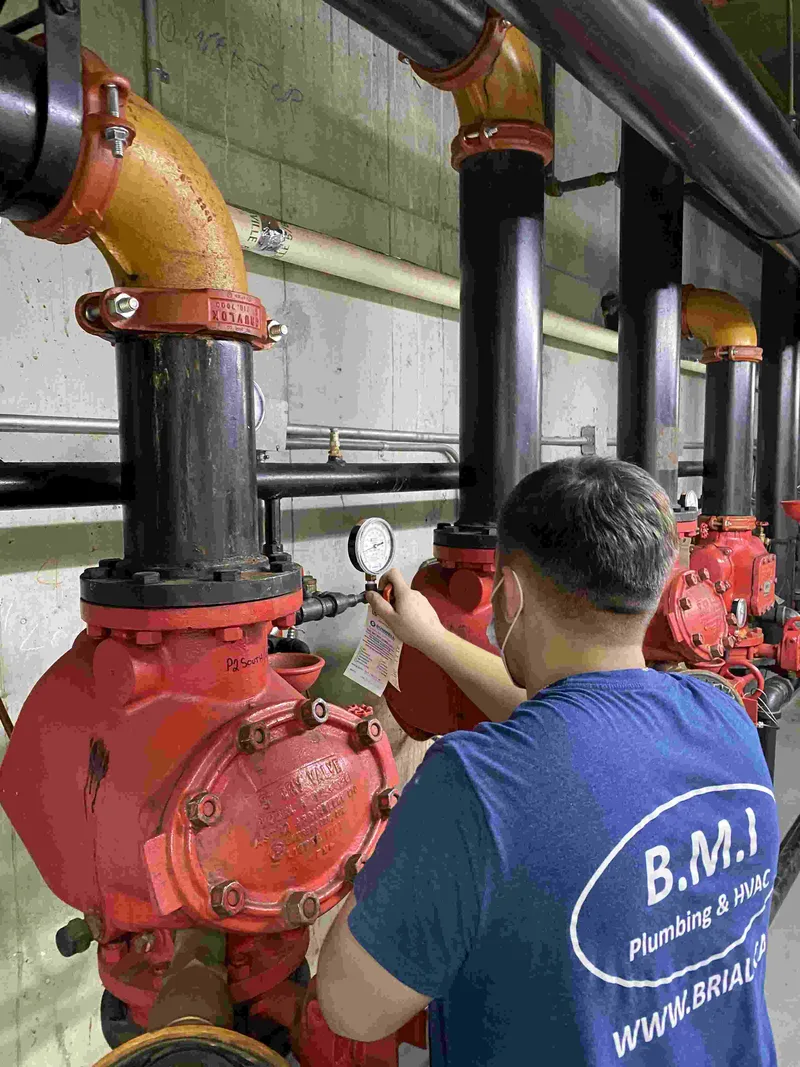
Each assembly is tested through the full procedure for its type: check valve tightness, relief valve opening differential and the integrity of the shut-offs, using a test kit with current calibration. The readings are recorded as taken rather than reconstructed afterwards.
-
Repair on the same visit wherever possible
Most failures are a fouled seat, a degraded rubber disc or a tired spring, and we carry the repair kits for the common assemblies. Rebuilding on the spot avoids a second attendance, a second shutdown and a device left failed in the interval.
-
Retest and certify
A repaired device is retested from the beginning of the procedure, not spot-checked, and the passing readings are what go on the certificate. Where an assembly cannot be brought to pass, it is quoted for replacement and the condition is reported rather than left.
-
File the report and diarise the next test
The completed report is submitted on the corporation's behalf and a copy goes into the building record. The next test date is diarised and we come back on schedule, so compliance is a service the building receives rather than a deadline somebody has to remember.
Compliance handled, not delegated back to management
The administrative burden is the part boards actually feel: tracking renewal dates, finding a certified tester, chasing a second visit after a failure and filing the result. We take all of it.
- A cross-connection survey listing every device and every point needing one
- Testing by certified testers using calibrated equipment, to CSA B64.10
- Readings recorded as taken, per device, on the City's report form
- Repair kits carried, so common failures are rebuilt and retested the same visit
- Devices mismatched to their hazard identified and quoted for correction
- Reports submitted on the corporation's behalf, with a copy for your records
- The next test diarised, so renewal is a scheduled visit rather than a deadline
Backflow prevention testing at a glance
| Service | Cross-connection survey, annual testing, repair and certification |
|---|---|
| Standard | CSA B64.10, tested by certified testers with calibrated equipment |
| Requirement | City of Toronto backflow prevention programme; comparable by-laws across the GTA |
| Frequency | Annually, unless the municipality specifies otherwise for a device |
| Devices covered | Reduced pressure, double check, vacuum breaker and dual check assemblies |
| Typical locations | Incoming main, boiler make-up, irrigation, cooling tower, wash bay, pool |
| Suite access | Not required; all devices are common element equipment |
| Building water off | Minutes, and only while premise isolation is being tested |
| On failure | Rebuilt and retested the same visit where parts allow; otherwise quoted |
| Reporting | Filed with the municipality on your behalf, copy to the building record |
| Service area | Toronto, North York, Etobicoke, Scarborough, Mississauga and the wider GTA |
| Emergency response | 24/7 for a discharging or failed device, (416) 845-3756 |
The tester who can also do the repair
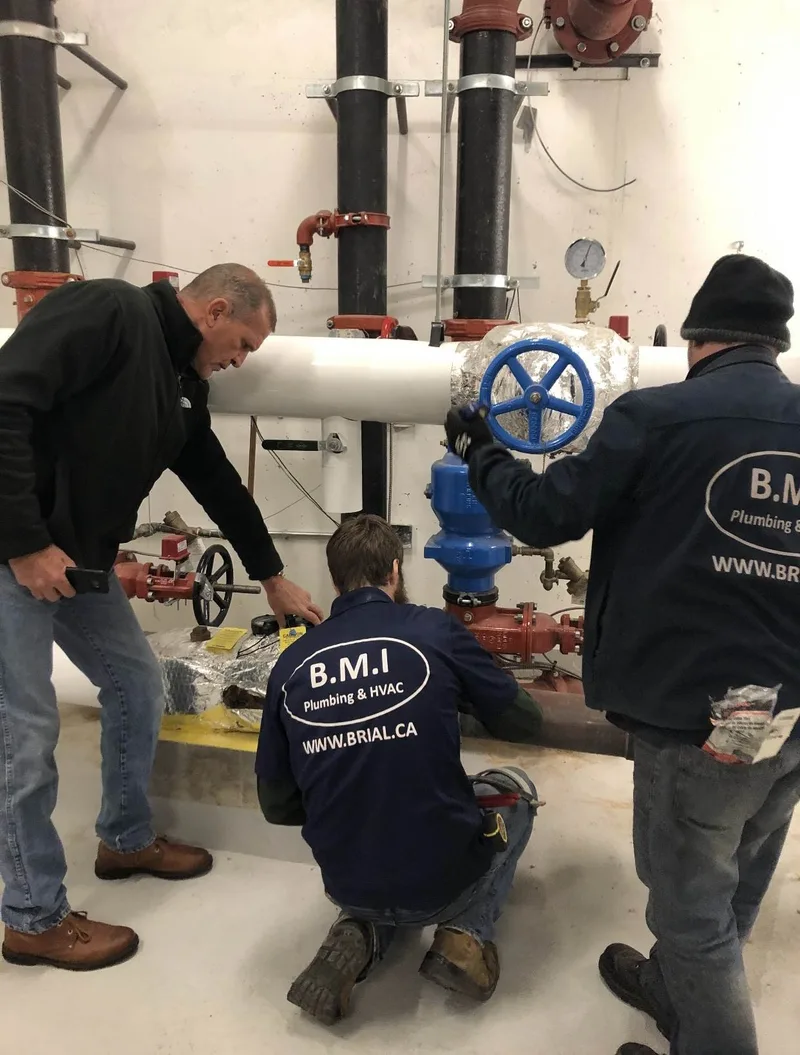
Testing-only contractors hand a board a failed report and a recommendation to call a plumber. BMI is the plumbing contractor, so a device that fails is rebuilt and retested on the same attendance, and one that needs replacing is quoted by the people who will install it. We hold maintenance contracts in the same buildings, which means the backflow devices are seen in the context of the mechanical room around them rather than as an isolated compliance item.
Backflow prevention questions
Backflow is water travelling the wrong way through a building's plumbing, back toward the drinking water supply. It matters because the water heading backwards may have picked up something on the way: boiler treatment chemicals, irrigation runoff, cooling tower water or anything else the building's systems contain. A backflow preventer is a mechanical assembly, normally installed on the incoming main and at each higher-risk connection, that allows water through in one direction and physically blocks it from returning.
Yes. The City of Toronto operates a backflow prevention programme under its water supply by-law, which requires owners of industrial, commercial, institutional and multi-residential properties to survey their buildings for cross-connections, install appropriate premise isolation, and have the devices tested by a certified tester on a recurring basis, normally annually, with the report submitted to the City. Other GTA municipalities run comparable programmes under their own by-laws. We handle the testing and the filing.
The City follows up on overdue reports, and the escalation path runs through notices to enforcement and, in principle, to interruption of the water service. In practice the more immediate consequences arrive sooner: insurers ask about it, engineers note it in building condition assessments, and it appears as a deficiency in status certificate enquiries. It is an inexpensive item to keep current and a conspicuous one to have outstanding.
Because a high-rise is not only residences. The building has a heating loop with treated water in it, make-up connections to that loop, very often irrigation, sometimes a cooling tower, a garage wash bay, a pool or spa, and janitorial sinks with hose connections. Each of those is a point where non-potable water sits at a pressure that could push back toward the supply. The residential suites are precisely what the protection exists to protect.
Two ways. Backsiphonage occurs when the supply pressure drops below the pressure in the building, which happens during a water main break, a large fire-fighting draw or upstream maintenance, and the line siphons backwards. Backpressure occurs when something inside the building pushes harder than the supply, which is the normal condition downstream of a booster pump set, a boiler circuit or an elevated heating loop. A high-rise routinely has both mechanisms present.
Testing any device means isolating it for a few minutes. For the in-premise devices that affects only the system it serves, such as irrigation or boiler make-up, and residents notice nothing. For premise isolation at the incoming main it does briefly affect the building, so it is scheduled with management, notified in advance and kept as short as possible. We sequence the visit so the interruption is minutes rather than hours.
No. Backflow devices are common element equipment and live in mechanical rooms, the garage, the irrigation room and similar service spaces. There is no suite access required for this work at all. The only thing a resident may notice is a short, notified interruption to the building supply if the premise isolation device is being tested that day.
A certified tester connects a calibrated differential pressure gauge to the test cocks on the assembly and works through the procedure defined for that device type. On a reduced pressure assembly that means verifying each check valve holds tight against reverse flow and that the relief valve opens at the correct differential. The readings are recorded on the report as taken. It takes minutes per device where the assembly is accessible and passes first time.
It has to be repaired or replaced and then retested, and a failed device is a real finding rather than a formality. Most failures are a fouled seat, a perished rubber disc or a weak spring, and we carry repair kits for the common assemblies so it is rebuilt on the same visit. Where the body is eroded, the device is obsolete or it is the wrong device for the hazard, we quote replacement and report the condition.
A reduced pressure assembly has a relief port underneath that is designed to discharge if either check valve stops holding. An occasional brief discharge during a pressure fluctuation is normal. A continuous or repeated discharge is the device telling you it has failed and is doing its job by dumping to atmosphere rather than letting anything back into the supply. Report it, do not plug it, and make sure the drain beneath it stays clear.
It can and should be directed to an air gap over a suitable drain, which is a normal part of a correct installation. It must never be capped, plugged or connected directly into a drain line. The relief port is the safety function of the device, and defeating it converts an assembly that protects the building into one that cannot. Where we find a capped or improperly terminated relief, it is recorded as a correction.
A reduced pressure assembly has two independent check valves with a relief valve between them, so if either check fails, the intermediate zone dumps to atmosphere and nothing gets back to the supply. A double check assembly has the two checks but no relief, which makes it simpler but means a failure is not self-announcing. The reduced pressure type is required where the hazard downstream is severe; the double check is used for moderate hazards. Matching the device to the hazard is the part that gets missed.
In a condominium, backflow protection is common element equipment on common element piping, so responsibility sits with the corporation and the cost falls under common expenses. Where an individual unit has had something installed that creates a cross-connection, for instance an unprotected hose connection or an unusual appliance, that specific protection may fall to the owner. In practice the survey identifies these and management resolves them case by case.
Yes, and it is the part boards most want off their desk. We complete the report for each device, submit it on the corporation's behalf, provide a copy for the building record, and diarise the next test date so we return on schedule. Management does not have to track renewal dates, chase a tester or field an overdue notice.
With the survey, because you cannot test a device nobody has identified and you cannot protect a connection nobody has found. We walk the building, document every existing device and every point requiring protection, assess the degree of hazard at each, and produce a schedule showing what is compliant, what needs a device and what has the wrong device fitted. From there the corrections can be planned and budgeted rather than discovered during an inspection.
The assemblies are long-lived, and with annual testing and periodic rebuilds many run for decades. What wears is the internals: seats, discs, springs and O-rings, and those are serviceable items replaced during a rebuild. Replacement of the whole assembly becomes the right answer when the body is eroded, the model is obsolete and parts are no longer available, or the device was never correct for the hazard it sits on.
Related programs and services
PRV Maintenance & Replacement
Pressure reducing valve service, rebuilds and replacement, set properly for every zone in the building.
Valve Audit & Exercise Programs
Every valve located, tagged and charted, then exercised annually so it still turns.
MEV Water-Saving Valve
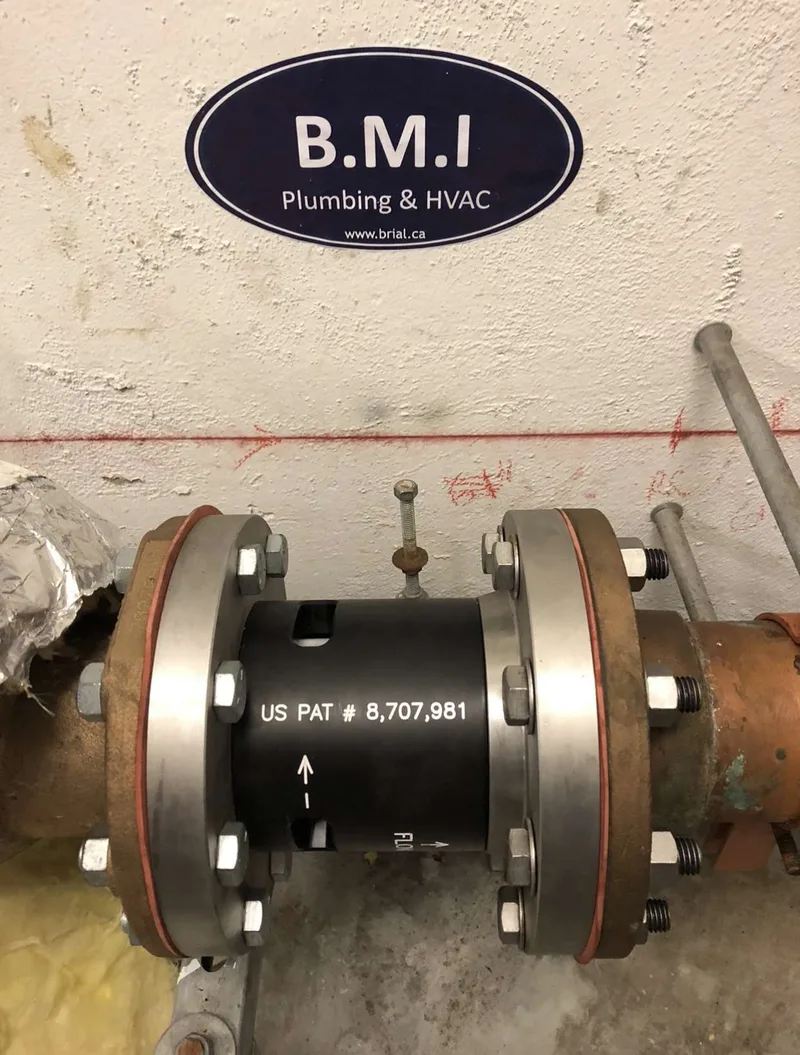
The meter efficiency valve that stops your water meter billing the building for air.
Put your backflow compliance on a schedule
Tell us what devices your building has, or let us survey and find out. We will test, repair what fails, file the report and come back before the next one is due.