
Kitchen Stack Cleaning for Toronto Condominiums
Grease builds up in a kitchen stack until a lower suite floods. We clean on a schedule, verify the result on camera, and identify the stacks that are past cleaning.
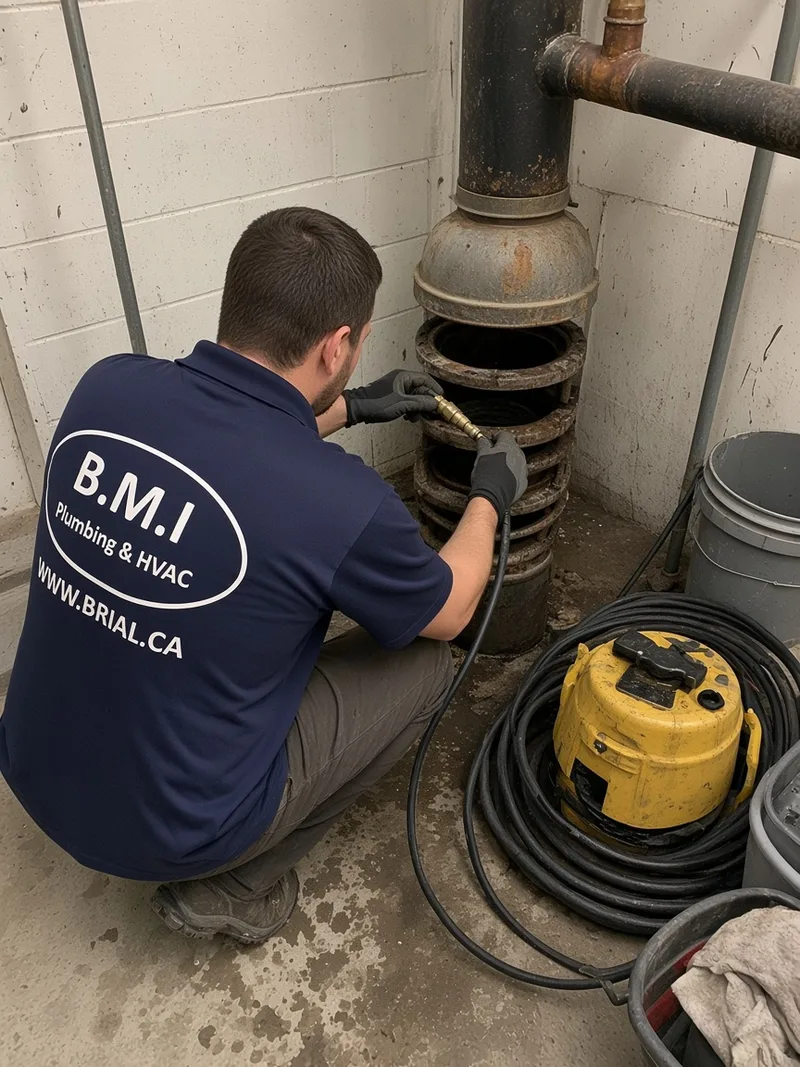
A blocked kitchen stack is never a one-suite problem
Warm fats and oils leave a suite as liquid, travel a few floors, meet cooler pipe and set on the wall. Every wash adds a layer. Food solids and coffee grounds catch on that surface, so the bore closes from the inside in until a four inch stack is passing water through an inch of clear space.
When it finally stops, the water does not remain in the stack. It backs up to the lowest fixtures on the column, so the suites that flood are almost never the suites that caused it. A single overflow can mean flooring, cabinetry and drywall across several units, mould remediation, a corporation insurance claim and a protracted dispute over apportionment.
Cleaning is maintenance. Replacement is capital.
Jetting restores the bore. It cannot restore pipe wall. Cast iron that has corroded to a thin shell, or that has failed at the hubs, has nothing sound to clean back to, and introducing pressure can open it. That is why we camera older stacks rather than assume, and why we will tell a board when cleaning a particular stack again is money that belongs in a replacement instead.
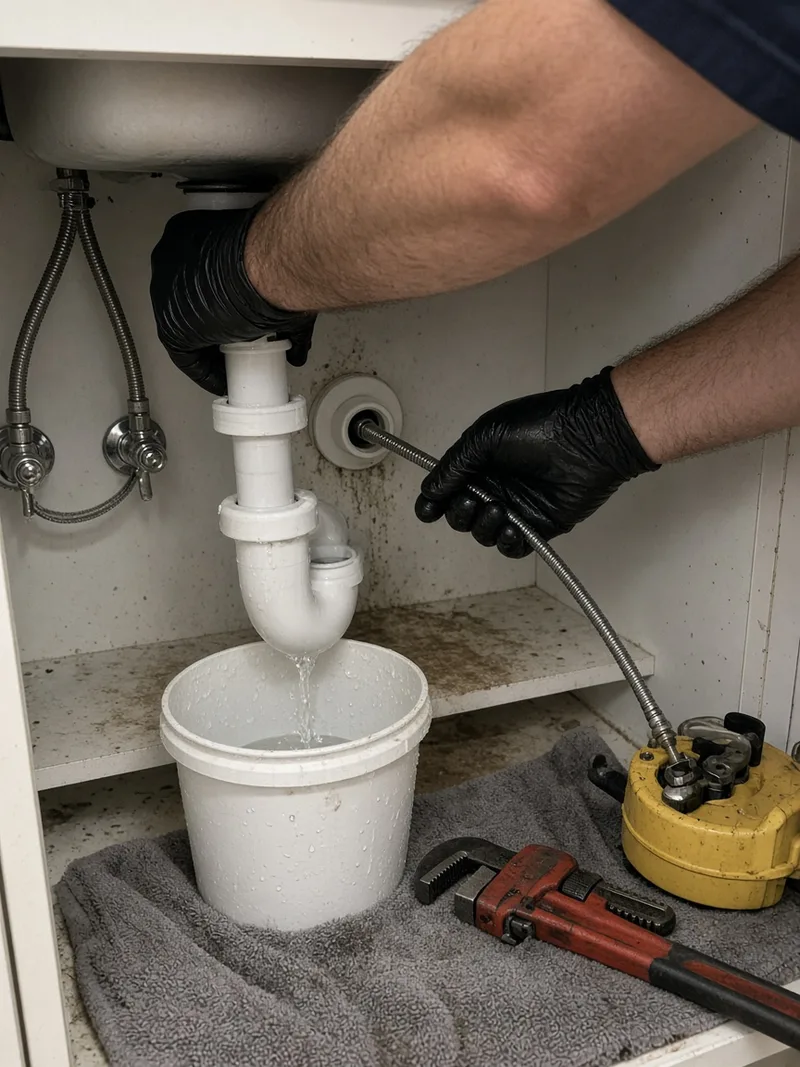
Signs your building's kitchen stacks need cleaning
A stack gives warning for months before it backs up. These are the complaints that warrant action rather than a log entry.
Gurgling at the kitchen sink
Air being pushed back through the trap when a suite above drains means the bore is restricted and the stack can no longer vent properly.
Slow sinks on the lower floors
The lowest suites on a stack feel a restriction first. If two or three of them report slow kitchen drains, the problem is the column, not the traps.
Repeat callouts to the same stack
Snaking the same branch twice in a year is a stack problem presenting as a suite problem. The line is being reopened, not cleared.
Sewage smell in a kitchen
Heavy grease holds standing water and gas against the pipe wall, and a stack that cannot vent draws that odour back into the suite.
Water rising in a lower suite
That is the stack backing up, and it worsens with every suite that runs water. Take the column out of use and call the same day.
No cleaning history at all
The stacks that fail are the ones never opened. Absent a cleaning record, age and grease loading are the entire risk assessment.
What is happening inside the pipe
How we clean a kitchen stack
The same sequence on every stack, in every building, so results are repeatable and the record still holds value at the next cycle.
-
Review the drawings and the history
We start with the riser drawings and your service records, so we know how many kitchen stacks the building has, where the cleanouts are, and which stacks have backed up before. Stacks with a history get looked at first.
-
Notice to residents
Property management approves the schedule, then every affected suite gets written notice of the date and the time window, with a short list of what to clear from under the sink.
-
Protect the access points
Floor and counter protection goes down at every access point, in suites and in common areas, before a tool comes out of the van.
-
Open the stack
We open the stack at the top, normally the vent through the roof, and at the base cleanout, so the full height of the pipe can be reached from both ends.
-
Jet the full bore
A rotating nozzle on a high-pressure hose is drawn through the stack in passes. That cuts the grease off the pipe wall, rather than punching a hole through the middle of it and leaving the rest to close up again.
-
Flush and remove the debris
Everything cut loose is flushed to the base and taken out at the cleanout, so softened grease is not left to set again further down the system.
-
Camera the cleaned stack
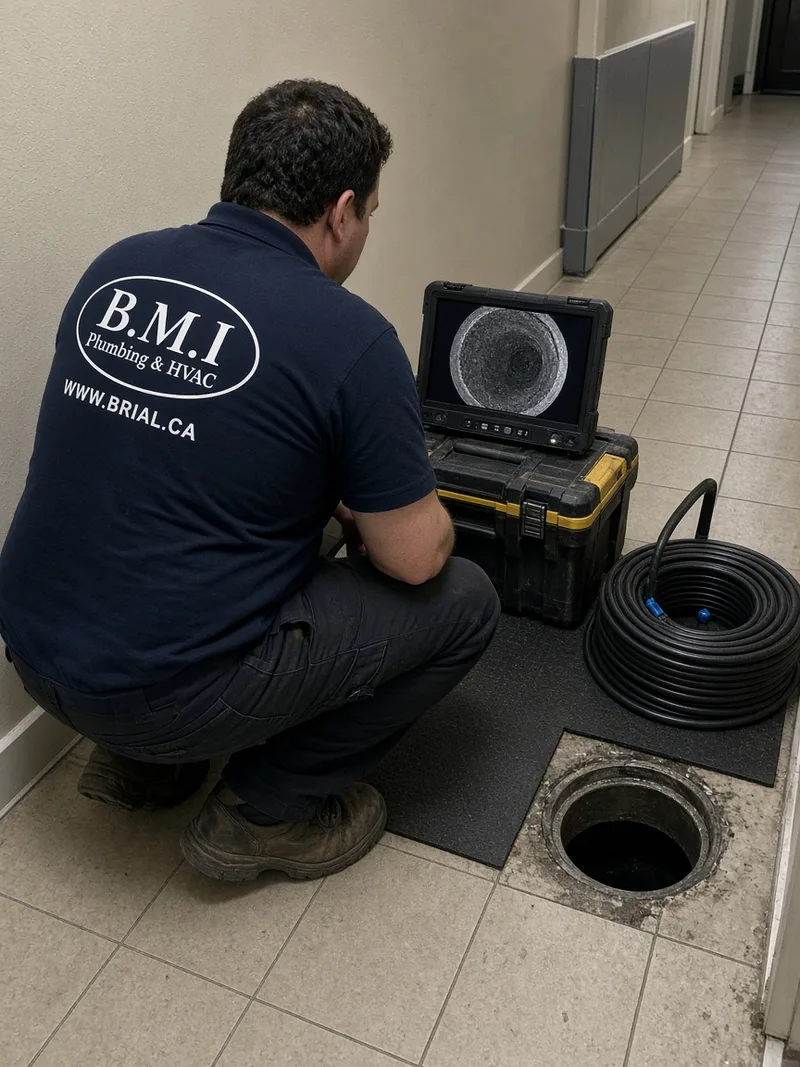
We run a camera through and record it. You see bare pipe wall, and we flag any cracks, failed hubs or thin sections found on the way.
-
Reinstate, test and report
Cleanouts are sealed, access points cleaned, fixtures run to confirm free flow, and you get a written report on every stack with a plain recommendation for each one.
A condition record, not only a cleaned pipe
A clean stack and a dirty stack are indistinguishable from the outside, which is why every job closes with evidence. The camera runs after the jetter, the footage is recorded, and the board receives something it can act on and file.
- A written condition report on every stack we opened
- Recorded camera footage of the cleaned bore
- A list of stacks that require replacement rather than cleaning again
- A recommended interval for each stack, based on what was actually found
- Defects logged in a form your reserve fund study can use
- Photographs of every access point, reinstated and cleaned up
Kitchen stack cleaning at a glance
| Service | Kitchen waste stack cleaning with camera verification |
|---|---|
| Building types | Condominium and rental towers, mid-rise buildings, stacked townhouses |
| Method | High-pressure water jetting with a rotating descaling nozzle |
| Typical frequency | Every 12 to 36 months, annually after a backup |
| Access required | Roof or top-floor vent, base cleanout, occasional suite access |
| Building water shut off | No |
| Resident impact | Kitchen sink out of use for a window on the day, on that stack only |
| Verification | Post-clean camera inspection, recorded |
| Deliverable | Written per-stack condition report and recommendation |
| Also available | Full kitchen stack replacement where the cast iron is past cleaning |
| Service area | Toronto, North York, Etobicoke, Scarborough, Mississauga and the wider GTA |
| Emergency response | 24/7 for an active backup, (416) 845-3756 |
The contractor that also does the replacement
Most drain cleaning companies stop at the jetter, and have no commercial reason to tell a board that a stack is finished. Because BMI replaces stacks and risers as capital work in the same buildings it maintains, our recommendation on cleaning interval and remaining service life carries no bias, and jetting pressure is matched to the measured condition of the cast iron rather than applied uniformly.
Kitchen stack cleaning questions
Kitchen stack cleaning is the scheduled removal of congealed grease and food solids from the vertical cast iron waste stacks that carry kitchen drainage down a condominium. A crew opens the stack at the roof vent and at the base cleanout, draws a rotating high-pressure nozzle through the full bore, flushes the debris out at the base, then cameras the pipe to prove it is back to bare wall. Most Toronto buildings need it every 12 to 36 months, and a building that has already had a backup usually belongs on an annual cycle.
Because the restriction is usually below you rather than under your sink. Grease leaves a suite as warm liquid and sets on cooler pipe further down the stack, so the narrowest point is often several floors lower. Your sink is the one that shows it first because it is closest to the section that has not backed up yet. If the trap and the branch under your sink are clear and the drain is still slow, the stack is the next thing to look at, and that is a corporation matter rather than something a resident can fix.
That is the classic sign of a restricted kitchen stack, and it means the pipe is close to blocking completely. When the bore has narrowed, water from a suite above cannot get past the restriction fast enough, so it backs up and comes out at the lowest open fixture, which is a sink a few floors down. Report it to property management the same day. A stack behaving like this does not get better on its own, and the suite that floods is almost always a low one.
We would ask you not to. Caustic drain cleaners do very little to hardened grease in a stack, they sit in the trap where they can damage older pipe and chrome fittings, and they make the line hazardous for whoever opens it next. In a condominium there is the added problem that the product is being poured into common element pipe shared with dozens of other suites. A plunger and hot water are worth trying on a slow trap; beyond that, put in a service request.
Nearly always one of three things. A trap that has dried out because the sink is rarely used lets stack gases into the kitchen, and running water for thirty seconds refills it and fixes it. A build-up of decomposing grease in the branch or the stack gives a sour, heavy smell that does not clear. Or the vent serving your stack is partly blocked, so the system pulls air through your trap instead of through the roof. The first is a resident fix, the other two are a service call.
Water, and as little else as possible. Fats, oils, butter, cream, salad dressing and the grease rinsed off a pan are the entire cause of kitchen stack blockages, and they go down as liquid and set as solid. Coffee grounds, rice, pasta, flour and starchy vegetable peelings then bind to that coating. Wipe greasy pans out with a paper towel into the garbage before washing them, and scrape plates rather than rinsing them. Hot water and dish soap do not solve it: they just move the grease further down the pipe before it cools.
It is, and many declarations prohibit them for exactly this reason. A disposal does not make food disappear, it turns it into a slurry of fine particles that is very good at sticking to a greasy pipe wall, and it encourages residents to put down the drain things that used to go in the garbage. In a building on a shared cast iron stack, one or two units with disposals can measurably shorten the cleaning interval for everybody on the stack. Check your rules before installing one.
Usually not. Most of the work happens at the two ends of the stack, which are the roof vent or top floor and the base cleanout in the garage or a service area. We only need to enter a suite when the stack has no usable access at one end, when a branch needs clearing separately, or when we are confirming flow afterwards. If your suite is one that needs access you will get written notice with the date and the time window in advance.
If we need to come in, clear the cupboard under the kitchen sink so the trap and the branch connection are reachable, and move anything valuable or fragile off the counter next to it. That is genuinely all of it. We bring our own floor and counter protection, and the crew will not need access to any other part of the suite.
It should not. Protection goes down at every access point before a tool comes out of the van, the debris from the stack is flushed to the base and taken out at the cleanout rather than pulled up through the suites, and the access point is cleaned before we leave. The one caveat is that this is drainage work, so there is an odour while a stack is open. It clears quickly once the cleanout is sealed.
For most of the working day if you are on the stack being cleaned that day, and not at all if you are not. There is no building water shutdown involved in stack cleaning, so showers, toilets and taps all keep working normally. It is only the kitchen drain on the stack being worked on that needs to stay unused while the line is open.
It depends on where the blockage was and what your declaration says, so the corporation and its insurer make that call rather than us. As a general rule, the vertical stack is a common element and the branch and fixture inside the unit are the owner's, which is why a blocked trap under one sink is handled differently from a restricted stack serving forty suites. Report it to property management immediately, photograph the damage before anything is cleaned up, and keep the invoices.
Most Toronto buildings sit on a cycle of every 12 to 36 months. What sets the interval is how much grease the stacks actually see and how they have performed in the past, not the age of the building. A tower with small kitchens and a good history can often stretch to three years. A building that has already had a backup, or that has original cast iron with heavy scale, belongs on an annual programme. We camera the stacks after cleaning, so the interval we recommend is based on the condition of your pipe rather than a generic schedule.
Cleaning removes what is inside the pipe. Replacement renews the pipe itself. Jetting takes congealed grease and scale off the wall and restores the original bore, which is maintenance and comes out of the operating budget. Replacement is needed when the cast iron has lost wall thickness, the hubs have failed, or the pipe is cracked, because at that point there is nothing left to clean back to. That is capital work. We camera older stacks precisely so a board is not paying to clean a pipe that needs replacing.
Usually not. Most of the work happens at the two ends of the stack: the vent through the roof or the top floor, and the base cleanout in the garage or service area. We only need to be inside a suite when a stack has no usable access at one end, when a branch has to be cleared separately, or when we are confirming flow afterwards. Where suite access is needed, residents get written notice of the date and window in advance and we lay floor protection in every unit we enter.
A typical stack in a Toronto high-rise takes most of a working day, including setting up protection, opening the access points, jetting the full height in passes, flushing the debris out, running the camera and reinstating everything. Buildings with several stacks are scheduled over consecutive days so residents are only affected once. Nothing about the work requires shutting the building's water off, and there is no disruption outside the suites on the stack being cleaned that day.
Sometimes, and sometimes it is the wrong question. Repeated backups on the same stack usually mean one of three things: the pipe is so restricted that a normal clean is no longer holding, there is a defect such as a failed hub or a broken section catching debris, or something about the way the stack was built is trapping solids. Jetting and cameraing together tell us which it is. If the stack is failing structurally we will say so and quote the replacement rather than sell you another clean.
In sound pipe, yes, and it is the only method that reliably removes hardened grease from the wall. In pipe that has already corroded through to a thin shell it can open a hole, which is why we do not simply jet everything at maximum pressure. On older buildings we camera first where there is any doubt, match the pressure and nozzle to the pipe's condition, and tell the board when a stack is too far gone for cleaning to be the right answer.
Warm fats and oils go down the sink as liquid, hit cooler pipe a few floors down and set on the wall. Every wash adds a layer, so the bore narrows from the inside in. Food solids, coffee grounds and starch then catch on that surface and build faster. Cast iron makes it worse because the interior wall is rough and corroded, which gives the grease something to hold. Nothing residents can reasonably be asked to do prevents it entirely, which is why scheduled cleaning is a building expense rather than a resident behaviour problem.
Yes. Every stack we clean is camera inspected afterwards and the footage is recorded, so the board can see bare pipe wall rather than take our word for it. The written report covers each stack separately, notes what came out, records any defects we found, and gives our recommendation and suggested next interval. That record is also what makes the next cycle easier to plan and what a reserve fund study needs when stack replacement starts appearing on the horizon.
The vertical stack is common element, so cleaning it is a corporation cost and normally sits in the operating budget as scheduled maintenance. The branch line and the fixture inside a unit are usually the owner's responsibility, which is why a blocked trap under one sink is handled differently from a restricted stack serving forty suites. Your declaration governs the specifics. Where a job touches both, we bill them separately so management is not left splitting one invoice.
Related programs and services
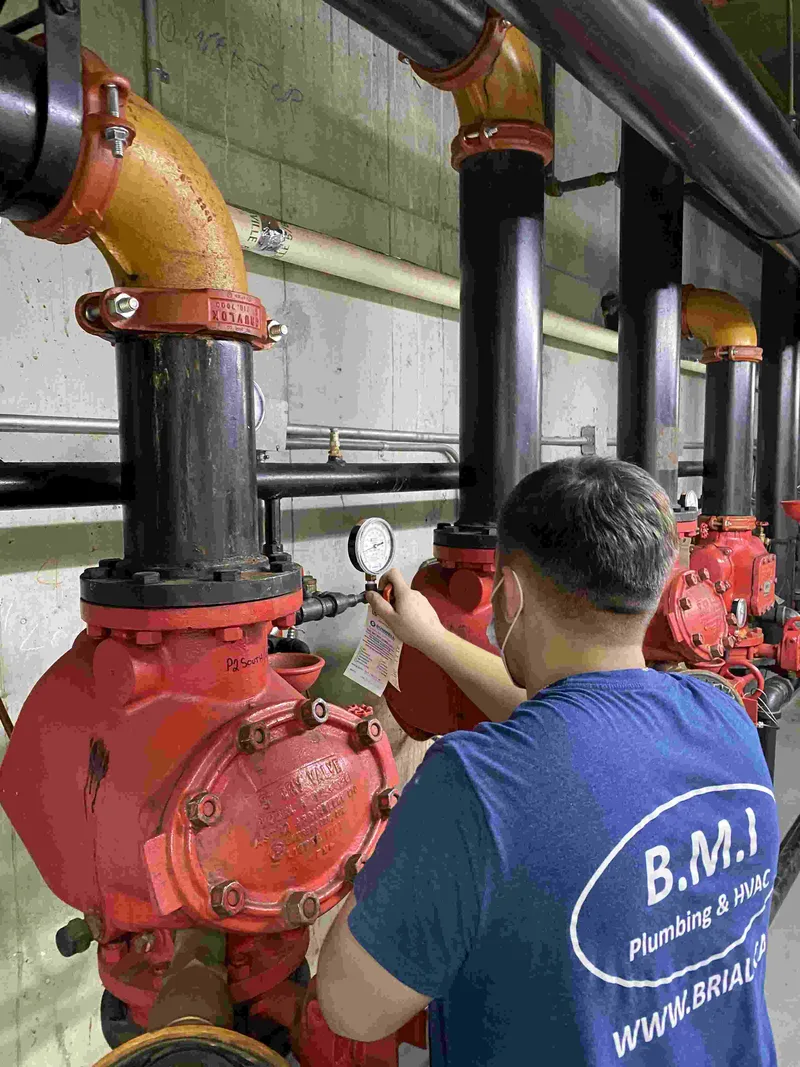
PRV Maintenance & Replacement
Pressure reducing valve service, rebuilds and replacement, set properly for every zone in the building.
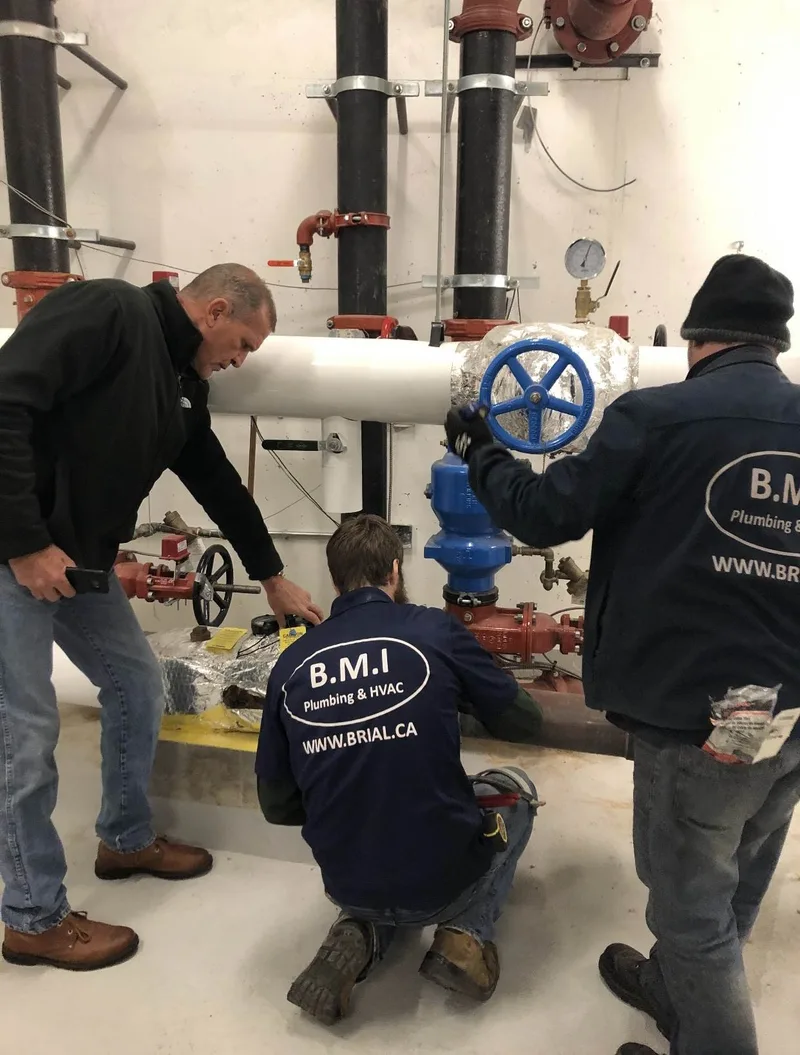
Valve Audit & Exercise Programs
Every valve located, tagged and charted, then exercised annually so it still turns when a pipe lets go.
Drain Cleaning & Snaking
Blocked sinks, tubs, toilets and floor drains cleared in suites and common areas, with the cause identified.
Put your kitchen stacks on a schedule
Send us the riser drawings, or just tell us which stack keeps backing up. We will walk the building, camera what we need to, and put a plain recommendation in writing.