
24/7 Emergency Leak Response
Leaks do not wait for business hours. Call any hour and you reach someone who can dispatch. We isolate the failure first to stop the damage spreading, then make the permanent repair.
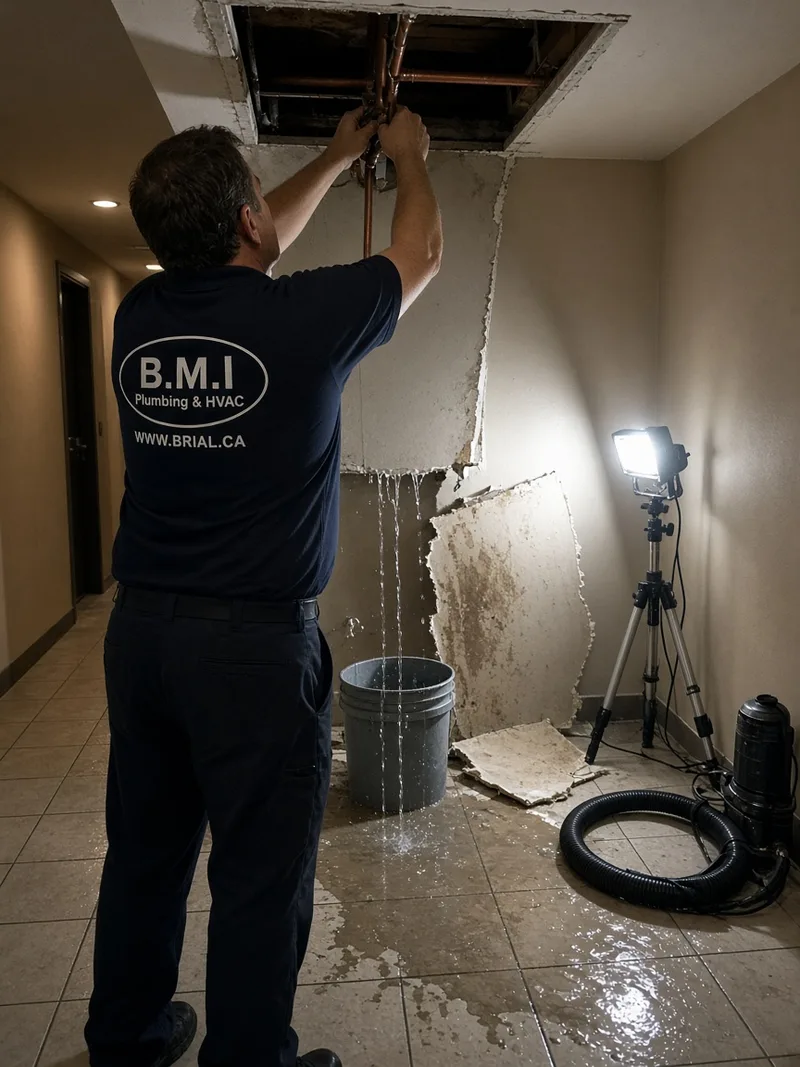
Isolation, not diagnosis, governs the loss
When a pressurised line fails, the failure itself is already fixed. What remains variable is the volume of water released, the number of units it reaches, and whether the event closes as a repair or as an insured loss. All three are decided by how quickly the correct valve is closed.
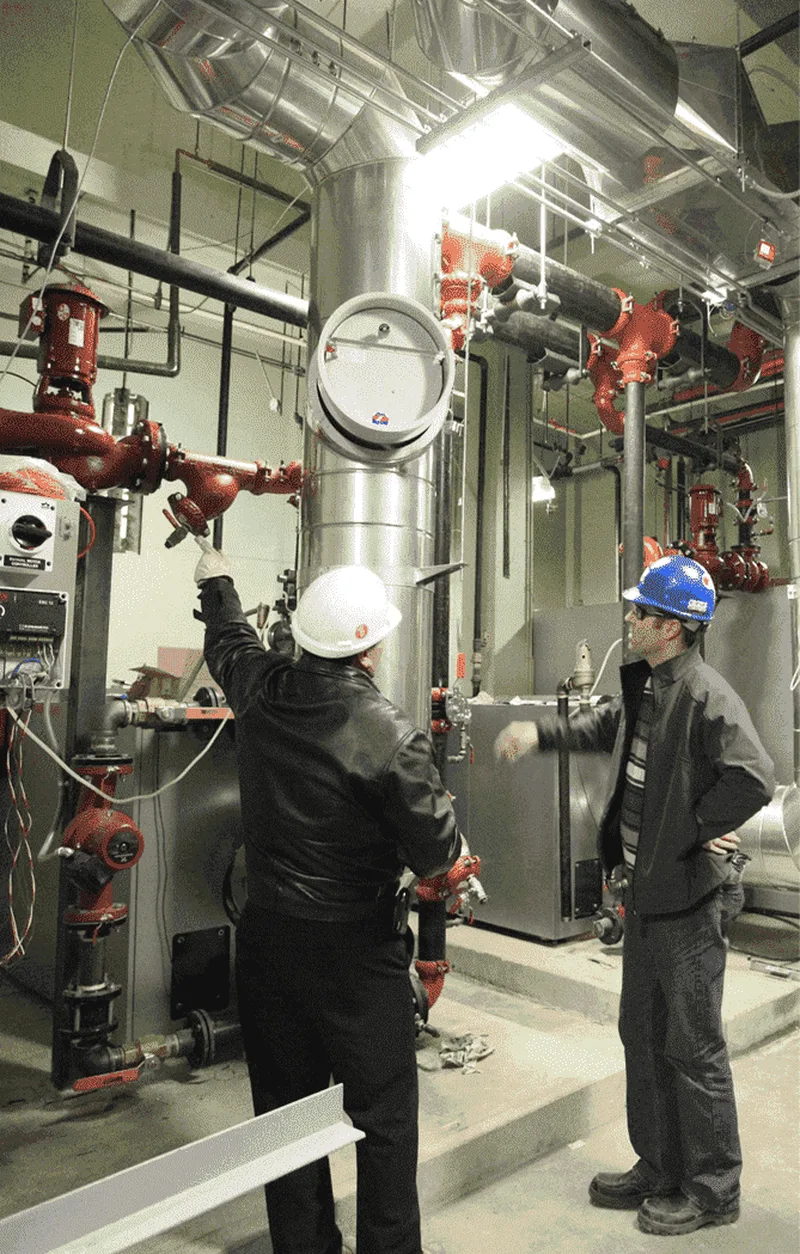
Our first action is therefore isolation at the smallest valve that will hold, working outward from fixture to branch, stack, zone and main. In a building with a current valve chart and a maintained exercise programme that is one stack, isolated in about fifteen minutes. Without one the sequence becomes trial and error, frequently terminates at the building main, and runs closer to two hours.
The source is seldom behind the evidence
Water escaping at height travels along the underside of the slab until it finds a penetration, and presents in a unit that can be well away from the failure. We trace the source with a moisture meter and thermal imaging before any finish is opened, which avoids a second opening, a second reinstatement and a second affected resident.
What counts as an emergency
Any of the following warrants an immediate call. The loss grows with every minute and with every fixture in use above.
Burst or split pipe
Water leaving a pipe under pressure. Isolate if you safely can, then call. Do not force a seized valve.
Water through a ceiling
The source is not in your unit. Isolate the breaker for that area, contain what you can, and involve management for access to the unit above.
A stack or drain backing up
Sewage backing into suites, a garage or a locker room. A health matter as much as a plumbing one, and it deteriorates quickly.
A valve that will not close
During a failure elsewhere, this becomes the emergency. It is why the isolation cascade climbs and the shutdown widens.
No water to a suite or stack
A sudden, total loss of supply indicates a failure somewhere on the system, and the cause is worth establishing the same night.
A failed water heater or tank
A failed tank discharges its contents and then continues to refill. Close the supply, isolate the power, then call.
How far the shutdown has to climb
What happens after you call
The sequence is fixed, because the sequence is what limits the loss.
-
Somebody who can dispatch answers
Not a voicemail and not an answering service taking a message for the morning. The call reaches someone who knows the buildings we look after, can establish the essentials, and can dispatch a crew while still on the call.
-
Isolate first
The priority is stopping water leaving the pipe, not diagnosing why it left. We work down from the smallest valve that will hold: fixture, branch, stack, zone, then main. A building with a current valve chart usually loses one stack for fifteen minutes. A building without one sometimes loses everything for two hours.
-
Contain what is already out
Water that has already escaped is still doing damage, and it travels along the underside of a slab and down through suites. We extract standing water, contain the spread and inspect the units below before the repair is addressed.
-
Find the actual failure
The stain on a ceiling is rarely under the hole. We trace it properly, with a moisture meter and a thermal camera where the water has travelled, so the wall being opened is the right wall rather than the first one.
-
Make it safe, then make it right
After hours, the correct measure is often a sound temporary repair that returns the building to service, with the permanent scope booked for a planned window. Which of the two has been carried out is always stated explicitly.
-
Restore service in the smallest possible steps
Water comes back on progressively and everything that was isolated gets checked and vented as it is returned, because refilling a system quickly is how the next weak joint is found.
-
Report while it is fresh
The report records the component that failed, the isolation taken and its timing, the repair carried out, the suites affected and the work outstanding. That document is what management provides to the insurer, and it carries far more weight written on the shift than reconstructed a week later.
Water stopped, and the record written on the shift
The plumbing element of an emergency closes within hours. The insurance and accountability element runs for months, and it is decided almost entirely by the documentation produced at the time.
- A dispatcher who can commit a crew at any hour, rather than a message service
- Isolation at the smallest valve that holds, taken ahead of diagnosis
- Standing water extracted and the affected area contained
- The source traced by moisture meter and thermal imaging before finishes are opened
- Temporary and permanent scope stated explicitly, never conflated
- A same-shift written report: component failed, isolation taken and its timing, units affected
- Suite and common element portions invoiced separately
Emergency response at a glance
| Service | Emergency leak, burst pipe, flood and backup response |
|---|---|
| Answered | 24 hours a day, every day of the year, including holidays |
| Who answers | Someone who can dispatch, not a message service |
| Covered | Suites, risers, stacks, mechanical rooms, garages and common areas |
| First action | Isolate at the smallest valve that holds |
| Leak tracing | Moisture meter and thermal imaging before anything is opened |
| Repairs | Temporary to restore service where needed, permanent repair scheduled and stated |
| Reporting | Written same-shift record for the corporation and its insurer |
| Restoration | Plumbing and our own wall repair; large-scale drying coordinated with your restoration contractor |
| Service area | Toronto, North York, Etobicoke, Scarborough, Mississauga and the wider GTA |
| Emergency line | (416) 845-3756 |
The contractor that knows the building before it arrives
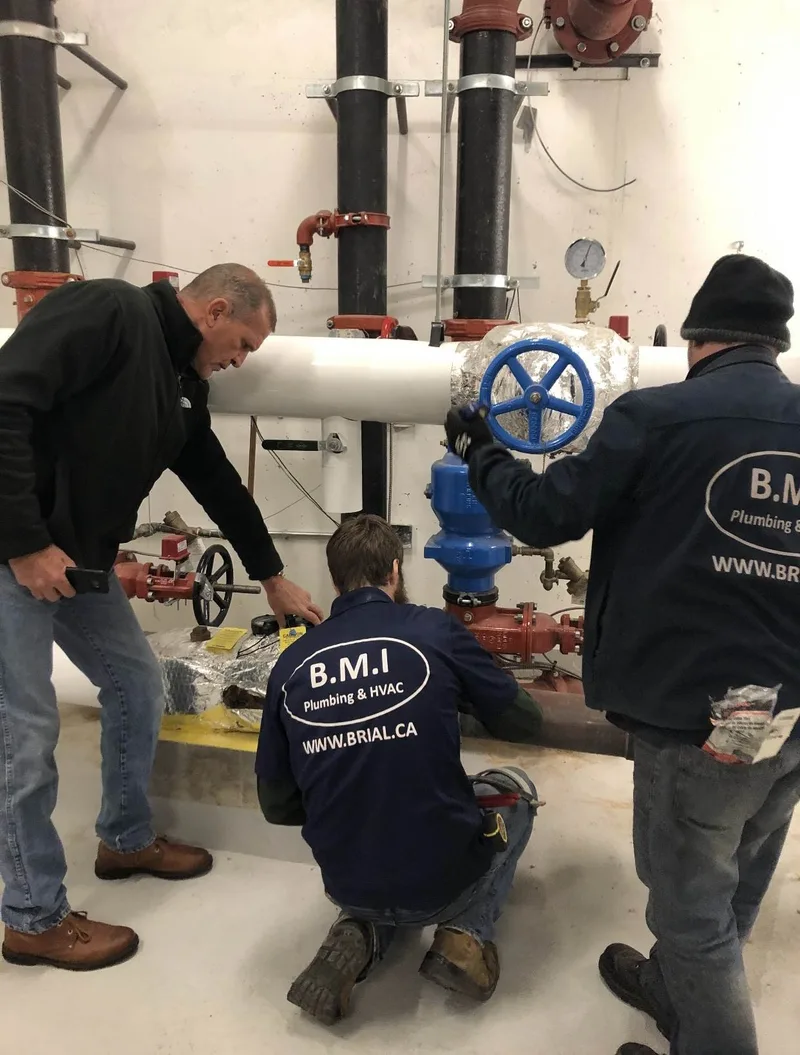
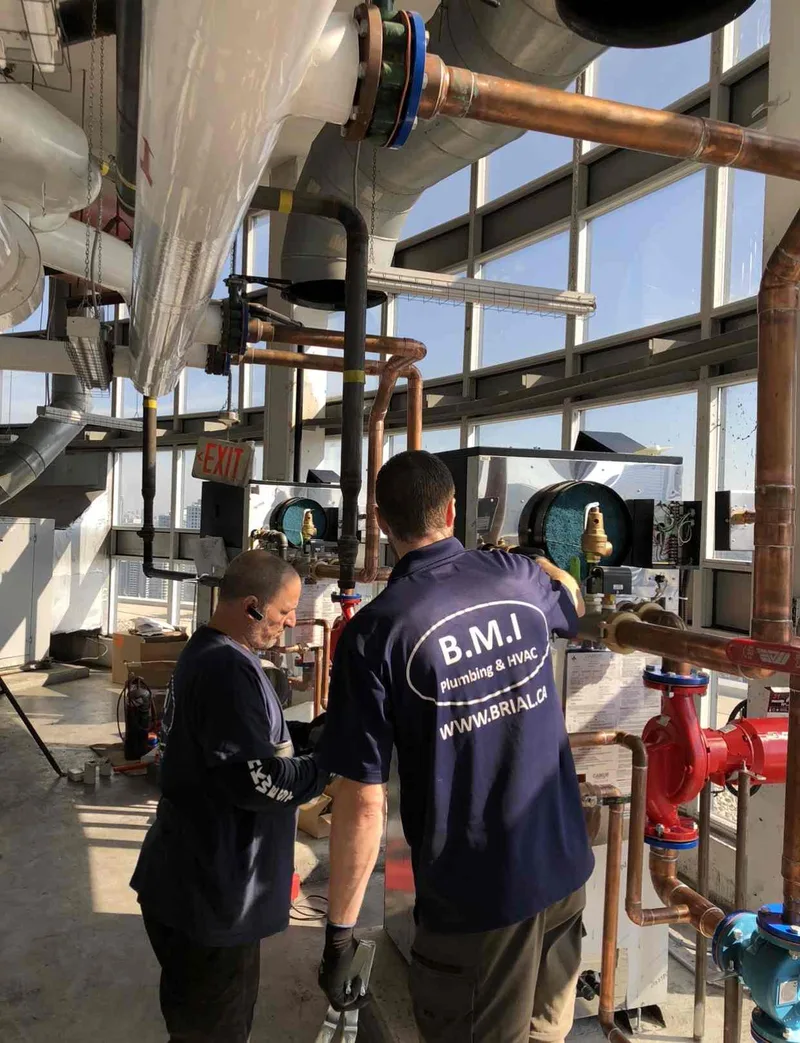
Response time on an emergency is largely a function of familiarity. BMI holds maintenance contracts in more than two hundred buildings, and in those buildings we arrive already holding the valve chart, the riser drawings and the service history. Our crews are in-house and licensed, we answer the line ourselves twenty-four hours a day, and we carry out the permanent repair rather than handing it to a third party.
Emergency plumbing questions
Shut your suite valve if you have one and it turns. Call the concierge or security so the building can be isolated, and call us on (416) 845-3756. Move what you can out of the water, put down towels, and turn off the electrical breaker for that area if water is anywhere near outlets, lights or panels. Photograph everything before you clean up, because that is what your claim will be built from. Do not force a seized valve and do not go into a ceiling that is holding water.
Yes, and you reach a person who can dispatch rather than a service that takes a message. That distinction is the whole point of an emergency number. Someone who knows the buildings we service can ask what is affected, work out whether this is a suite problem or a riser, and have a crew moving while still talking to you.
For the buildings we hold maintenance contracts with, quickly, because we know where the mechanical rooms and the isolation points are before we arrive. Across the GTA generally, response depends on the hour and on where the crews are, and we will give you a real time on the phone rather than a number designed to end the call. What we will also do is tell you what to isolate in the meantime, which is often worth more than the arrival time.
Report it to the concierge and to property management immediately, because the source is not in your unit and somebody needs access to the suite above. Put buckets down, move furniture, and kill the breaker for any circuit in that ceiling. Do not poke or drain the bulge yourself. When we arrive we trace the source rather than assume it is directly above the stain, because water runs along the underside of a slab and can travel a long way from where it started.
Anything actively releasing water that cannot be stopped by a resident: a burst or split pipe, a failed supply line, a leaking riser, water coming through a ceiling or a wall, a stack or building drain backing up into suites or a garage, a failed water heater, a seized valve during another failure, and no water at all to a suite or a stack. A dripping tap and a running toilet are not emergencies, though a running toilet is worth reporting the same week because of what it does to your water bill.
Turn off your own suite valve if you have one and it moves easily. Leave the building main to building staff or to us. In most towers the main is not a single tap, the order things get closed in matters, and slamming a building main shut on an old system can cause its own damage. If nobody on site knows what to close, that is exactly the call to make to us, because we can talk somebody through it.
Because to stop water leaving a pipe you need a valve upstream of it that closes properly, and in buildings where those valves have seized, the next one that actually holds might be the zone or the building main. That is why a one-suite failure can become a building notice. It is also the strongest argument there is for a valve audit and an annual exercise programme: the difference is one stack for fifteen minutes versus the whole tower for two hours.
Whichever the situation calls for, and we will say which one you are getting. At three in the morning with a building without water, a sound temporary repair that restores service safely and a permanent fix booked for a planned day is often the right answer. What we will not do is present a stopgap as a completed repair and leave it on your building for a year. Whatever we do overnight goes in the report along with what still needs doing.
It depends on what failed and what your declaration says, and property management makes that determination rather than us. Broadly, a failure in the common element piping, the risers or the mechanical plant is a corporation cost, and a failure of something inside the unit, such as a supply line, a fixture or a water heater, is usually the owner's. We document what actually failed and where, which is the fact that decides it, and we invoice suite and common element work separately.
Your unit policy and the corporation's policy interact, and the deductible on a condominium water claim can be substantial. We are not insurance advisers, so take the details to your broker. What we can tell you is what makes claims go smoothly: photographs taken before cleanup, a written record of when the leak was found and when it was isolated, and an invoice that identifies the failed component. Insurers ask how long isolation took, and that answer is decided by the building's valves long before the leak happens.
Four things, in order of how often they would have helped. Know where your suite shut-off is and check once a year that it turns. Replace rubber washing machine hoses and old flexible supply lines with braided stainless ones on a schedule rather than when they fail. Shut your water off when you travel. And report small things: a weeping valve, a toilet that runs, a stain that appears and dries. Most of the floods we attend were visible as something minor first.
We handle the plumbing: isolating it, finding it, repairing it, and closing the wall where our work opened it. Large-scale remediation, dehumidification and restoration of finishes is specialist work and your corporation will usually have a restoration contractor for it. We coordinate with them and hand over a clear account of what failed and what was affected, because the first thing they need to know is whether the water is stopped.
Yes, subject to crew availability. Response is faster in buildings we already service, because we arrive holding the valve chart and knowing where the mechanical rooms and isolation points are. If we are attending your building for the first time during a failure, the isolation is worth reviewing afterwards; the event will generally have demonstrated something about the valves.
Water hammer is the shock of moving water being stopped suddenly, and it is the banging you hear in a wall when a tap or an appliance valve closes. On its own it is not an emergency, but it is not harmless either: the same shock loads joints and fittings, and it is usually a symptom of pressure being set too high. Report it, because it tends to be the thing a building notices in the year before it starts seeing leak repairs.
Related services
Valve Audit & Exercise Programs
Every valve located, tagged and charted, then exercised annually so isolation takes minutes instead of hours.
Clogged Drains & Snaking
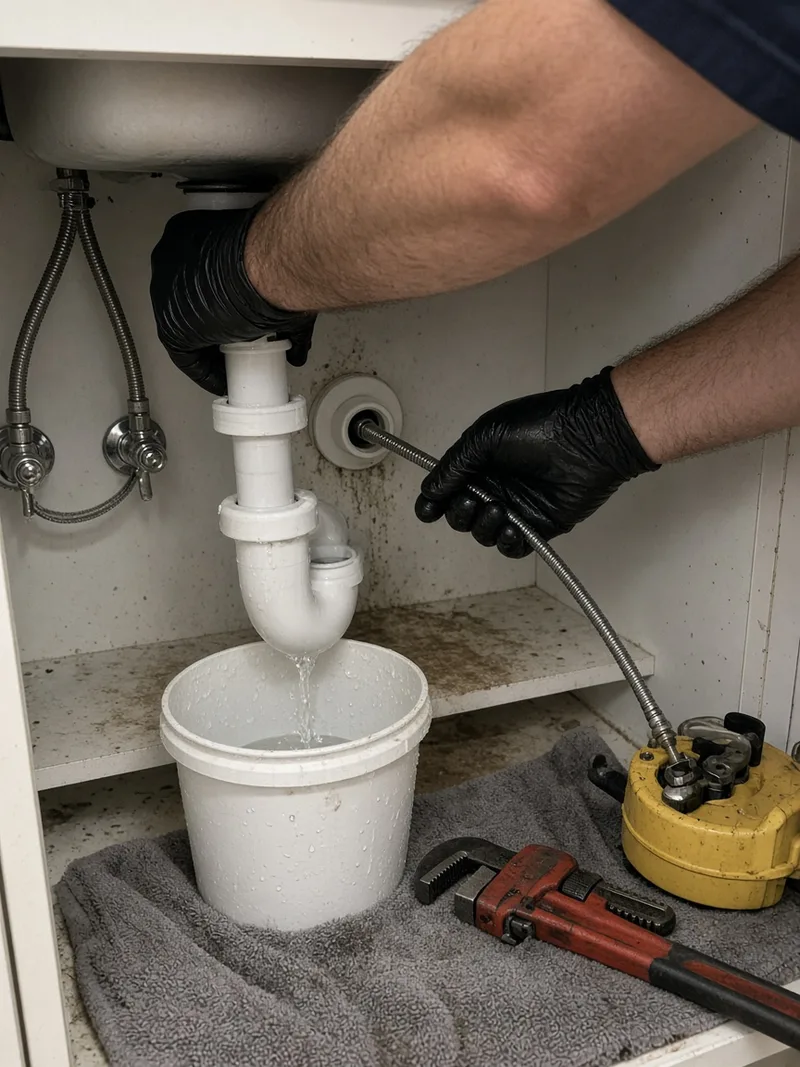
Blocked sinks, tubs, toilets and floor drains cleared, with the cause identified rather than guessed.
Riser Replacement
When the leaks stop being isolated incidents, the risers are the answer rather than another repair.
Put our number somewhere you can find it
The worst time to look for a plumber is while water is coming through a ceiling. If you manage a building in the GTA, it is worth a conversation before that night rather than during it.