
Clogged Drains & Snaking in Toronto Condominiums
Sinks, tubs, toilets and floor drains, in suites and in common areas. We clear the line, establish why it blocked, and report whether it is likely to recur.
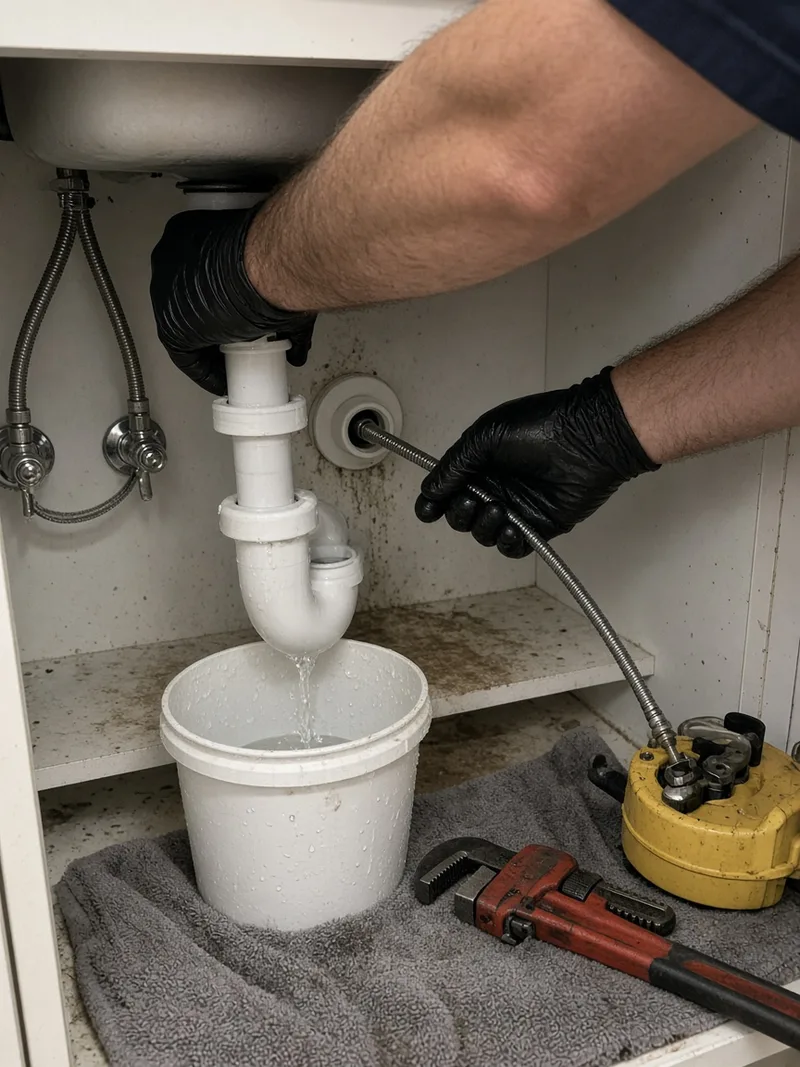
Locating the restriction is the engineering problem
A drain complaint arrives as a single symptom. The scope of the remedy is set by where the restriction sits in the drainage system, and that can be established diagnostically before any access point is opened.
The count of affected fixtures locates it. One slow fixture indicates the trap or the fixture branch. Two fixtures in a single room indicates the shared branch. An entire suite indicates the branch-to-stack connection. Several suites on one column indicates the stack, which is common element pipe and carries a different method, a different scope and a different cost allocation.
Recurrence is a defect, not a frequency
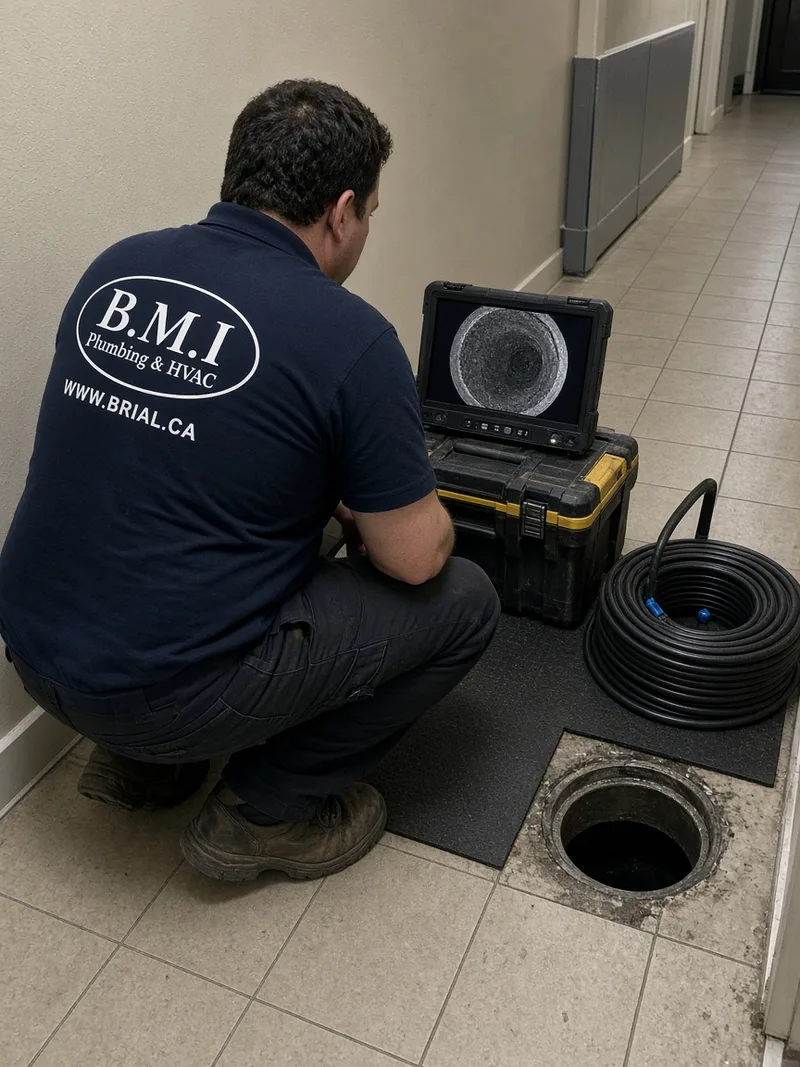
Clearing a blockage and correcting its cause are separate scopes, and buildings routinely fund the first repeatedly in place of the second. A line that blocks more than once in a year is doing so for a physical reason: grease deposition along the full run, a failed hub, a fractured section, a low point retaining solids, or a vent that was never adequate. CCTV inspection resolves it in under half an hour and converts a recurring operating cost into a defined repair.
What your drain is telling you
The pattern of affected fixtures determines the method, the equipment required and the urgency of the response.
One fixture draining slowly
The trap or the fixture branch immediately past it. Hair, grease or soap scum, cleared mechanically.
Two fixtures in one room
A sink and a tub going slow together means the shared branch behind the wall, not either fixture.
Backing up when a neighbour runs water
That is the stack, and it is close to blocking completely. Report it the same day; the suite that floods will be a low one.
Water coming up a floor drain
The building drain can no longer carry what is entering it. Urgent, and not something to leave until morning.
Gurgling from another fixture
Air drawn through a trap because the vent or the line is restricted. The noise indicates the system can no longer vent properly.
The same drain, again
Twice in a year indicates a physical cause. This is where a camera inspection saves money rather than spending it.
Which fixtures are affected tells you where the blockage is
How we clear a drain
Diagnosis precedes access. The sequence is the same on every call, in every building.
-
Establish how far it reaches
The first question is not which drain is blocked, it is how many fixtures are affected and whether the neighbours have it too. One slow sink is a trap or a branch. Two fixtures in one room is the branch. A whole suite, or several suites on a column, is the stack, which changes the method, the equipment and the cost allocation.
-
Protect the area
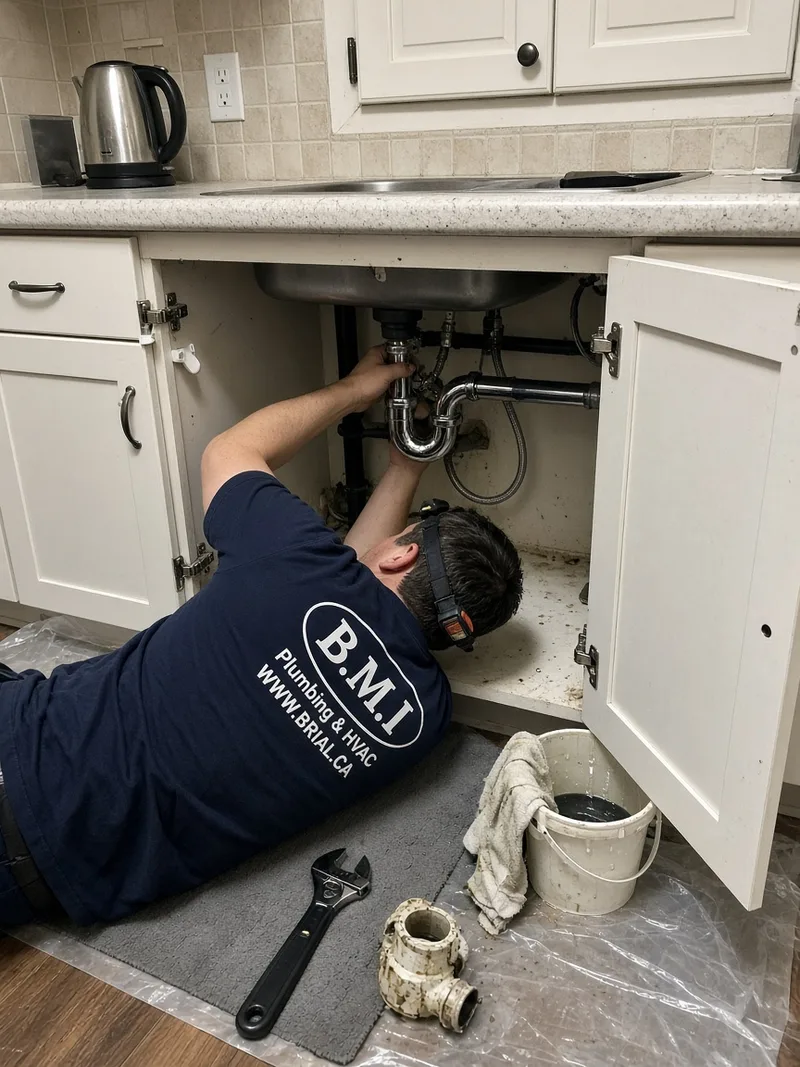
Floor protection, cabinet protection and a bucket go down before anything is opened. Drain work is dirty by nature, and containing it is part of the scope.
-
Open at the right point
We work from the nearest sensible access, which is usually the trap, the cleanout or the fixture itself, rather than driving a cable the length of the system from the far end. Access selection largely determines how quickly the line clears.
-
Clear the line
A hand or powered snake for a branch, a closet auger for a toilet, and a high-pressure jetter where the line is greased up rather than plugged by an object. Method is matched to the cause and to the condition of the pipe, because full jetting pressure is not appropriate on thin cast iron.
-
Prove the flow
The fixture is run under full volume rather than briefly. A line that accepts a full basin without backing up is clear; a line that still drains slowly once the immediate obstruction has gone remains restricted, and is reported as such.
-
Find out why, if it repeats
Recurrence has a physical cause. We camera the line and identify it: grease coating, a failed hub, a broken section, a belly in the line, roots in a building drain, or a fixture that was never vented properly.
-
Clean up and report
The trap is reassembled with new seals where required, the area is cleaned, and the finding is issued in writing: what was removed, the assessed cause, and whether the line requires anything beyond clearing.
Flow restored, cause identified, condition recorded
The prevailing standard in this trade is a cleared line and a verbal assurance. We close the work against a defined standard instead: proven flow, a method matched to the pipe, and a written cause that tells the building whether clearing is a sufficient remedy.
- Flow proven under full fixture volume rather than a nominal run
- Method matched to the cause and to the condition and age of the pipe
- Floor and cabinet protection installed, access point reinstated and cleaned
- Traps reassembled with new seals where condition requires them
- CCTV inspection on any line with a recurrence history
- A written cause, and a recommendation on whether clearing is sufficient
- Suite and common element portions invoiced separately
Drain cleaning at a glance
| Service | Drain cleaning, snaking, augering and high-pressure flushing |
|---|---|
| Fixtures | Sinks, tubs, showers, toilets, laundry, floor and trench drains |
| Lines | Traps, branches, stacks, building drains, garage and common area drains |
| Response | Same day for booked calls, 24/7 dispatch for active backups |
| Diagnosis | Camera inspection where a line has blocked before |
| Water shut off | Not required |
| Protection | Floor and cabinet protection in every suite entered |
| Reporting | What came out, the likely cause, and whether clearing is enough |
| Billing | Suite and common element portions invoiced separately |
| Service area | Toronto, North York, Etobicoke, Scarborough, Mississauga and the wider GTA |
| Emergency line | 24/7, (416) 845-3756 |
We also replace the pipe we inspect
A contractor who only clears drains has no commercial reason to tell a board that a stack has reached the end of its service life. BMI delivers stack and riser replacement as capital work in the same buildings it maintains, so our recommendation on whether a line should be cleaned again or scheduled for replacement carries no bias. Jetting pressure and nozzle selection are matched to the measured condition of the pipe rather than applied uniformly.
Clogged drain questions
In a condominium there are four likely answers, and which fixtures are affected tells you which one. If it is one sink only, the trap or the pipe immediately after it is coated or plugged, usually with grease, hair, soap scum or something dropped down it. If the sink and the tub in the same bathroom are both slow, the blockage is in the shared branch behind the wall. If every fixture in the suite is slow, the blockage is where the branch meets the stack. And if your neighbours above or below have it too, it is the stack itself and it is a corporation matter.
We advise against it. Caustic cleaners act on some soft organic material and do almost nothing to hardened grease, hair wound around a stopper, or a solid object. They then sit in the trap, where they attack older metal pipe and chrome finishes, and they leave the line hazardous for whoever opens it next. A plunger and hot water are reasonable first measures. Beyond that, mechanical clearing removes the obstruction rather than chemically softening part of it.
Some of them, yes. Pulling the pop-up stopper out of a bathroom sink and cleaning the hair off it solves a surprising share of slow bathroom drains. A plunger, used properly with the overflow covered, clears many toilets and sinks. Cleaning a tub strainer and the visible part of the drain is fine. Where we would stop is taking a trap apart if you are not certain you can get it back together, and using a drain bladder or high pressure on old pipe. If the same drain keeps coming back, the cause is further in than a resident can reach.
Three common causes. A trap that has dried out, which happens in a spare bathroom or a floor drain that is rarely used, lets sewer gas straight into the room, and running water for thirty seconds refills the seal and fixes it. Decomposing grease and biofilm in the branch gives a sour, persistent smell that comes back after cleaning the fixture. And a blocked or restricted vent makes the system pull air through your trap instead of through the roof, which smells worst when a neighbour's fixture drains. The first is a resident fix; the other two are a service call.
Because they share a branch and that branch is restricted. The tub is usually the lowest opening on the run, so when the line cannot take the volume, the water comes out at the tub rather than backing up into the higher fixture. It is the same principle as a low suite flooding when a stack is restricted, just on a smaller scale. This is a branch blockage, and it needs clearing rather than living with.
It means the drainage below that point cannot take what is being put into it, and the floor drain is the lowest opening available. In a condominium that usually points at the building drain or the base of a stack rather than anything in your suite, and it can affect a garage, a locker room or a laundry room. Treat it as urgent and report it immediately: it is both a health matter and a sign that a main line is blocking. Do not add more water to the system while it is backing up.
Often, yes. Use a proper flanged toilet plunger rather than a flat sink plunger, seat it fully over the outlet, and use steady pushes rather than violent ones. Do not keep flushing to see if it has cleared, because that is how a blocked toilet becomes a flooded bathroom. If two or three attempts do not move it, stop and call: a closet auger reaches round the trap of the bowl where a plunger cannot, and if the blockage is actually in the branch beyond the toilet then nothing you do at the bowl will fix it.
Cooking fats, oils and grease, which are the single largest cause of blockages in a residential building. So-called flushable wipes, which do not break down and which we pull out of condo stacks constantly. Paper towel, cotton pads, dental floss, hair from a brush, cat litter, coffee grounds, rice and pasta, and anything fibrous or stringy. Also worth knowing: in a shared stack, what your neighbours put down affects you, which is why buildings with recurring problems often see them on the same few columns.
For a blocked fixture that is not causing damage, we book a window and get there the same day or the next, coordinated with property management. For anything that is actively backing up or flooding, call the 24-hour line and we dispatch: a backing-up stack or building drain is treated as an emergency because the damage grows with every fixture somebody upstairs uses. Our number is the same at three in the morning as it is at three in the afternoon.
Sometimes, and property management arranges it rather than you. Clearing a branch or a stack may need access at a cleanout that happens to sit in another suite, or we may need to run a fixture upstairs to confirm flow after the work. We keep that to the minimum, and any suite we enter gets the same floor protection and the same clean-up as the one that reported the problem.
Your declaration decides it, and property management makes the call rather than us. The usual division is that the fixture, the trap and the branch inside your unit are the owner's responsibility, and the vertical stack and the building drain are common elements. That is why a blocked trap under one sink is billed differently from a restricted stack serving forty suites. Where one visit deals with both, we invoice the two parts separately so nobody has to split a single bill.
Used correctly, no. The risk is not theoretical though: a powered cable driven hard through old, thin cast iron or through a pipe that is already cracked can make the damage worse, and full-pressure jetting on a corroded shell can open a hole. That is exactly why we match the tool to the pipe, and why we camera anything we are not sure about before escalating the method. A contractor who reaches straight for maximum pressure on a sixty-year-old stack is not being thorough.
Because clearing a blockage and fixing a cause are two different jobs. A line that comes back is usually doing so for a physical reason: grease coating the full length rather than a single plug, a failed hub or a cracked section catching debris, a low spot holding water and solids, a fitting installed at the wrong angle, or a vent that is not doing its job. A camera answers it in twenty minutes. If a plumber has cleared the same drain three times and never looked inside it, you are paying for the same visit repeatedly.
A snake is a cable that bores through or hooks out whatever is blocking the line. It is the right tool for an object, for hair, and for getting flow back quickly. Jetting uses high-pressure water through a rotating nozzle to scour the pipe wall back to its original bore, which is the only thing that properly removes years of hardened grease. Snaking a greased-up line punches a channel through the middle and it closes again; jetting it cleans it out. The choice is about the cause, not about which is better.
Yes. Floor drains in garages, locker rooms, laundry and mechanical rooms, trench drains, garbage room drains, exterior area drains and the building drain itself are all part of what we handle for the buildings we look after. These are the lines nobody thinks about until a garage floods, and they are worth being on a schedule in any building that has had a problem before.
In most cases, yes. A drain camera goes in through an existing access point and shows the inside of the pipe on a screen, so we can see grease, scale, cracks, failed hubs, offsets, roots and standing water, and locate them by distance along the run. That turns a guess into a decision, and it is what we hand to a board when a line has gone beyond cleaning and needs a section replaced.
Related services
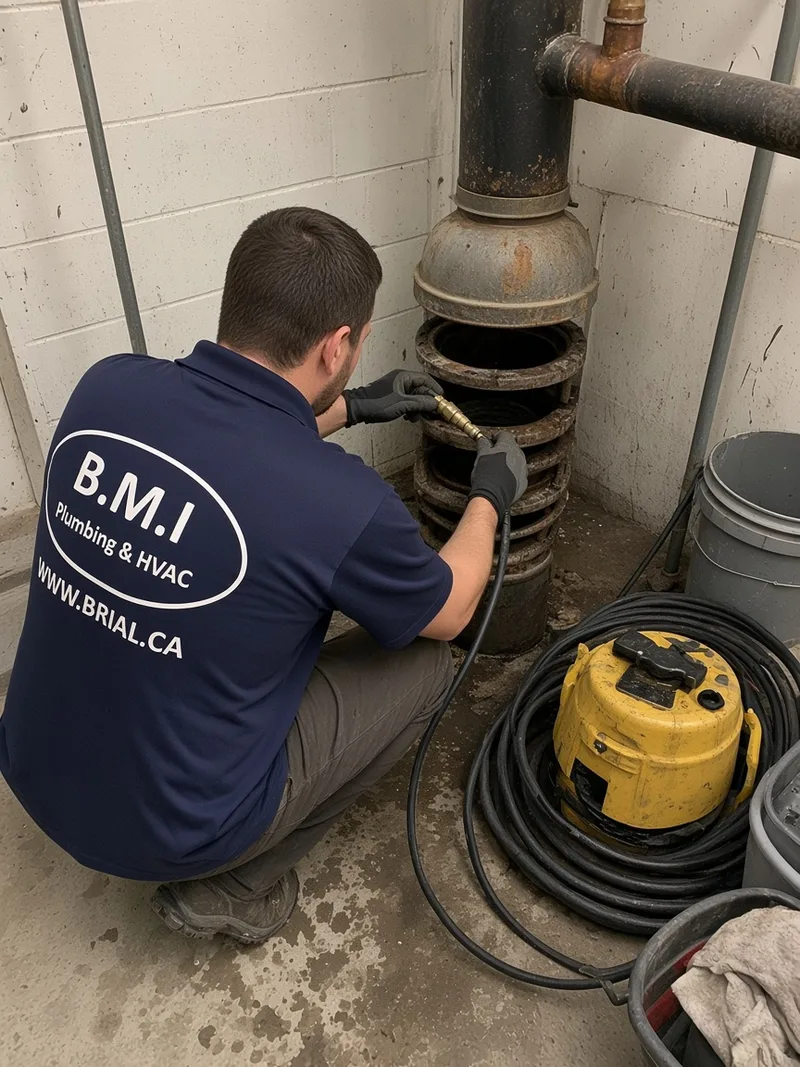
Kitchen Stack Cleaning
Scheduled jetting of the building's kitchen waste stacks, camera verified, before a low suite floods.
24/7 Emergency Leak Response
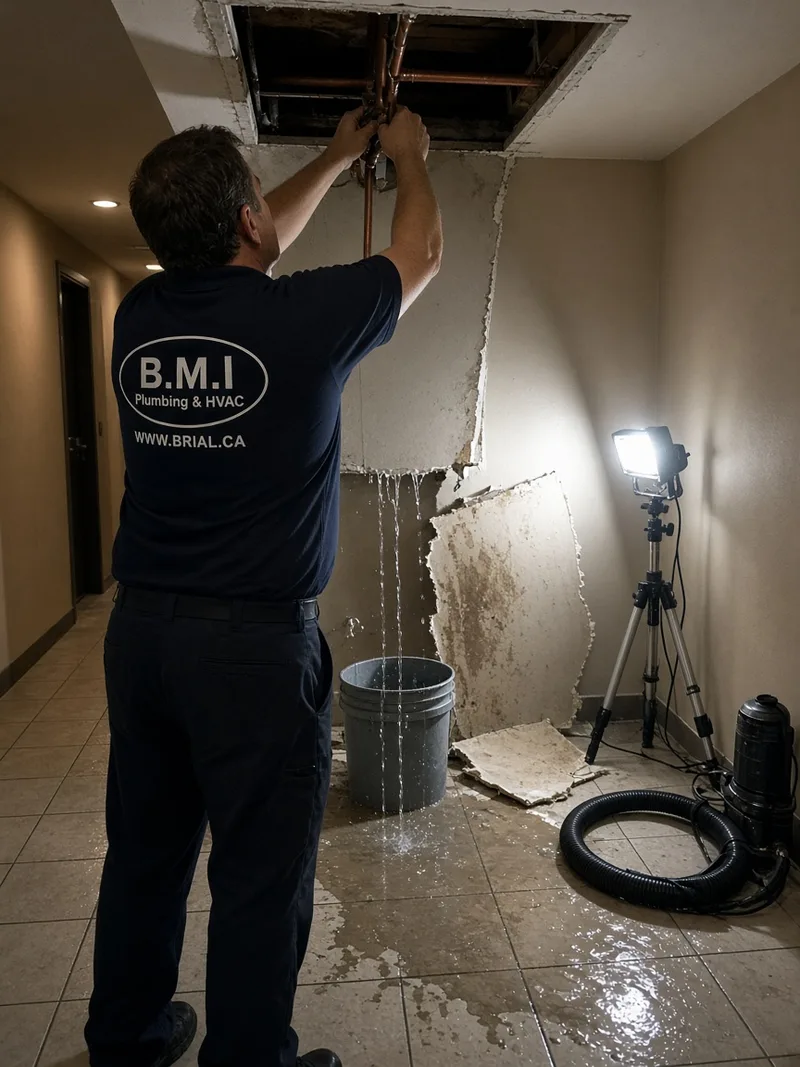
Burst pipes, active leaks and backups answered at any hour. Isolate first, then repair properly.
In-Suite Plumbing Repairs
Taps, toilets, shut-offs, supply lines and drains inside the unit, on booked windows with protection down.
Got a drain that will not clear?
Tell us which fixtures are affected and whether the neighbours have it too. That one answer usually tells us what is coming out of the van, and we can be there the same day.